Saturday, 25 July 2015

Disputes over Islands in East & South East Asia: A Solution

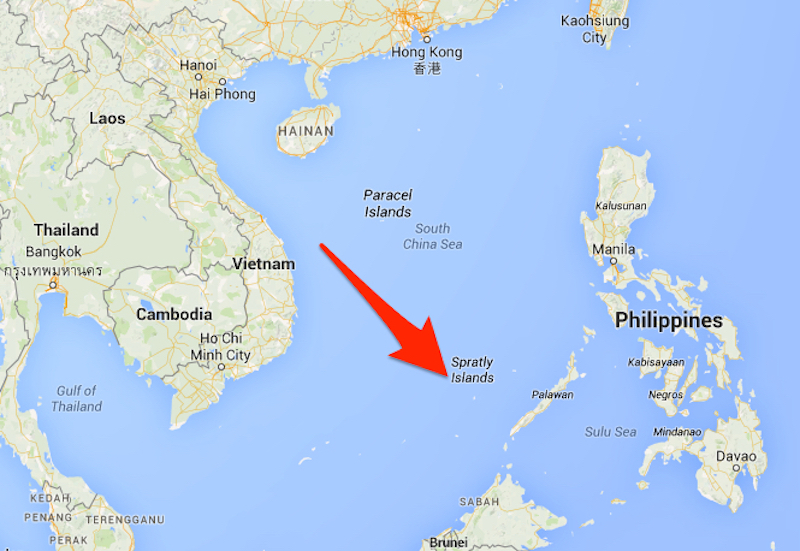
Tensions have been mounting between members of the ASEAN, China & Taiwan over competing claims on Islands in the South China Sea For details see
They are not alone. East China Sea is the new theatre of conflict between China, Taiwan & Japan over the Senkaku Islands (Diaoyu islands in China) - eight uninhabited islands and rocks with an insignificant area of about 7 sq. km. Likewise Japan & Russia are ranged against each other over the control of islets - called Southern Kurils (Northern Territories in Japan) While Kurils – an island chain - stretches north across the Pacific Ocean from the Japanese island of Hokkaido
to the southern tip of Russia's Kamchatka Peninsula dispute over ownership is restricted to four islands - Kunashir (known in Japanese as Kunashiri), Iturup (Etorofu), Shikotan and the rocky Habomai.

The reasons for claiming ownership is strategic - considering their proximity to shipping lanes & existence or potential for establishment of military bases & economic – availability of fish, gas & oil reserves & the tourism potential. Rare rhenium deposits have also been found on the Kudriavy volcano on Iturup island enhancing its importance further. An understanding of history is necessary to gain an insight into the origins of current claims.

Historical claims of Ownership over the Senkaku Islands
Post the Sino-Japanese war, Taiwan was ceded to Japan under the Treaty of Shimonoseki, in 1895 & the Senkaku islands incorporated into Japanese territory. After World War 2, Japan renounced claims on Taiwan under the 1951 Treaty of San Francisco while the Senkaku islands, came under US trusteeship and were returned to Japan in 1971 under the Okinawa reversion deal. Japan’s claims rest on the fact that neither China nor Taiwan raised any objections to the San Francisco deal then. China with claims over Taiwan suggests that when Japan renounced claims over Taiwan, the islands too, should have been deemed to be returned. Taiwan did not protest then, China avers, because Taiwan's Kuomintang leader, Chiang Kai-shek, depended on the US for support.

Historical Claims of Ownership over the Kuril Islands
Japan ownership of the four southern islands was cemented by the Treaty of Shimoda, in 1855, when diplomatic relations were first established between Russia and Japan.  As per the subsequent Treaty of St. Petersburg, in1875, it was agreed that Japan would give up all rights to Sakhalin on the Kuril Islands. Russia thereafter took control of the islands at the end of WW2 and by 1949 had deported all 17000 residents to Japan. 


Japan renounced rights over Kuril Islands under the 1951 San Francisco Peace Treaty with the Allied forces; since Russia did not sign the treaty and Japan never recognised the four islands as part of the Kuril chain, the issue continued to fester. While a Japan-Soviet Joint Declaration restored diplomatic ties in 1956 a formal peace deal remained elusive despite Russia’s proposal to return the two islands closest to Japan which the latter rejected because the two islands represent only 7% of the land in question.
Current Problem on Senkaku
The current controversy erupted in April 2012, when the right-wing Tokyo Governor Shintaro Ishihara, announced that he would use public money to buy 3 Senkaku islands from their private Japanese owner. The Japanese govt. blocked the move & bought it itself which provoked China to organize both public & diplomatic protests. It upped the ante through incursions into what Japan sees as its territorial waters & escalated the situation further by creating a new air-defence identification zone (ADIZ), in November 2013, which required any aircraft in the zone to comply with their rules which is unacceptable to Japan & the US.
Current Problem on Kuril
Political opportunism & push towards nationalistic jingoism has exacerbated the dispute. Former President, Dmitri Medvedev, became the first leader of Russia to visit the disputed isles, in 2010 & repeated the move again in 2012 prompting an outrage from Japan.  Boosting of Russian defences on the islands in 2011 was not viewed kindly by Japan. The Russia-Japan détente has not been made easier by the recent Russia- China embrace & the September 2010, joint statements committed to “support each other on sovereignty, unity and territorial integrity.”

Analysts argue that the wording is ambiguous on Northern territories while specifically mentioning joint support for their positions on Taiwan, Tibet, Xinjiang, the Caucasus region and former Soviet countries. They buttress their argument further by alluding to the world atlas published by the Chinese People’s Liberation Army, that shows the Northern territories as “Occupied by Russia” next to each of the four disputed islands with names in Japanese & not Russian – a stand maintained by China since the 1960’s; therefore it is unlikely that China & Russia would form a joint front against Japan.

However many in Japan fear a Chinese threat.

Resurgent Japan
Post defeat in WW 2, Japan, changed its constitution to a pacifist one that specifically barred its troops from moving beyond its shores. The US entered into a security alliance with Japan & formalised it in 1960 as per which the US is provided military bases in Japan in lieu of a promise to defend Japan in the event of an attack. The current Japanese, PM Shinzo Abe, has sought to add muscle to the military alliance through the proposed “Diamond” project involving India, US, Japan & Australia to counter the growing Chinese threat. He has also proposed a change in Japanese Constitution to allow Japanese forces to be sent abroad which has since been passed by the Diet albeit with the entire opposition walking out. Its passage in the upper house is still due.  If the same is unlikely to pass muster, Abe has proposed military assistance to like-minded countries to counter the threat. Tensions are on the rise since all the countries have taken maximalist positions.
Likely solutions
If the parties to the dispute are keen on a peaceful “Win - Win “solution then the same is not unreachable. A humanitarian outreach to create the environs for a negotiated settlement should be the first step. The outreach by the erstwhile Soviet President Mikhail Gorbachev is a guiding light.
Requests for visits to the graves of the ancestors of displaced Japanese of the Kuril was first made in 1964 & post a long lull allowed after the visit of then Soviet President, Gorbachev to Japan in 1991.  As a provisional measure mutual visits - without passports or visas - between Japanese citizens and the current Russian residents of the Northern Territories was allowed to enhance mutual understanding to prepare grounds for an eventual peace treaty. Once trust is achieved some mechanism of joint investment & administration could be evolved.
Kurile islanders are Russian citizens but live in hardship since fishing proceeds subject to about 80% tax & appropriated by the Russian govt. causing much local angst. Boris Yeltsin unsuccessfully attempted to change that in December 1992, when he issued an order to create Kuril Islands free economic zone, cut taxes, give rights to keep foreign currency earned through trade and the power to impose quotas on foreign vessels fishing in Kuril waters. The proposal floundered when the Duma balked then & the population shrank by a third following the devastating earthquake in 1994. There is immense sense in reopening the proposal & inviting Japan to invest in an arrangement which allows joint administration of the northern territories by a board with equal membership by both the parties. The Taiwan- Japan agreement offers an interesting template.

In April 2013 Taiwan reached agreement with Tokyo to permit Taiwanese fishing vessels access to fishing areas near the Senkaku/Diaoyu Islands and inside Japan’s exclusive economic-zone, thereby decoupling the issue of sovereignty & economic rights around the islands. The same template could be employed by China too to freeze the conflict to be revisited at a later state when relations between the neighbours improve.
Michael o’Hanlon, director of research for the Foreign Policy program at the Brookings Institution, Professor Akikazu Hashimoto of the J.F.Oberlin University Graduate School and Wu Xinbo of China’s Fudan University in Shanghai have proposed a permanent solution to the Senkaku problem. As per their proposal Japan would continue to retain formal administrative rights under international law which would be a concession by China while Japan’s concession would be to agree to delegate the administration of the islands to a joint oversight board with equal memberships on the Chinese and Japanese sides, rotating chairmanship, and consensus decision making rules. Patrols for purposes of safety, and tours of the islands for reasons of tourism or ecology or history, would be organized and conducted together by China and Japan and regulated by the board; Unilateral patrols around the islands by any ships or planes from either side would end. All patrolling within the 12-mile zone bordering the islands would be done jointly. The islands would be used solely for non-military purposes such as ecological tourism, with all such activities fully regulated by the oversight board.

Apart from the above both sides would promise to raise no further territorial disputes in future by acknowledging the sovereignty claims over all the islands by the other. This shall potentially prevent China from challenging Japan’s sovereignty over any of the Ryukyu Islands in the future. Likewise the two sides would agree to decouple matters of territory and sovereignty, and the Law of the Sea will not apply to any claims to the islands.

Conclusion
This solution if accepted by the effected parties has the potential to reduce tensions in the region & beyond & if successful would also serve as a model to manage disputes over islands across the world.

Friday, 17 July 2015

Geopolitics of Artificial Islands: China’s attempt to dominate the Seas

The rapid rise of China to a $ 10 trillion economy - the 2nd largest in the world – is nothing short of spectacular.  If military budget is seen as a proxy of military might, China is the 2nd largest military power too. It is only a matter of time before China emerges as the Numero Uno, in both the areas, leading to the prediction that the 21st Century shall be a “Chinese Century” just as the 19th Century was the British Century or the 20th Century was the US century. Ideologists though would prefer the term “Asian Century” signalling that India is no pushover & shall fight for its place in the sun. With a $2 trillion economy – the 7th largest in the world & the 3rd as per Purchasing Power Parity (PPP) – they are, perhaps, not off the mark.

With a population of about 1.4 billion, China accounts for about 20% of humanity – the largest of any countries -  & therefore its rise is truly epochal & welcome; however its belligerence is not.  The Chinese' fail to appreciate that with “great power comes great responsibility” & their aggression in the South China Sea (SCS) does not instill comfort. While countries in the region were earlier disturbed by Chinese claims on islands like the Paracels & Spratlys, it has now evolved into paranoia post their attempt to create artificial Islands which shall serve as military posts.

Why the Conflict?
As per the United Nations Convention on the Law of the Sea (UNCLOS), 1982, every country has 12 nautical miles of territorial sea & a 200 nautical miles Exclusive Economic Zone (EEZ).  As per the US council on foreign relations report SCS accounts for 11 billion barrels of oil & 190 trillion cubic feet of natural gas.  $5.3 trillion of international trade passes through the SCS - 23% of which is of the US; therefore America too is concerned with the developments in the region.

Historical Claims on Spratlys
China claims exclusivity over almost the entire SCS, vide the “Nine dashed line” which is contested by the other countries in the region because of the above mentioned strategic & economic reasons. Spratlys are hundreds of tiny shoals, reefs and islets in the South China Sea claimed by China, Taiwan, Vietnam, Malaysia & the Philippines. China claims historical “sovereignty” on these land masses for over 2000 years & had released a map in 1947 detailing its claims which are mirrored by Taiwan. Vietnam claims documentary proof of ruling over this territory since the 17th century & asserts that China never laid claim over these islands before 1940’s. Philippines claims rest on geographic proximity while Malaysia on the principle of EEZ. Brunei has no claims on islands but Malaysia claims a small number of islands in the Spratlys

Conflicts over Paracels, Spratlys & Scarborough Shoal
China supports its territorial claims with military force to achieve strategic objectives. Chinese forces seized the Paracels from Vietnam in 1974 & the Scarborough Shoal from the Philippines in 2012.  In July 2012 China consolidated gains by formally created Sansha city - an administrative body with headquarters in the Paracels – to oversee Chinese territory in the South China Sea. In 2014 Chinese naval and coastguard ships ventured into Vietnam’s exclusive economic zone (EEZ) to support the activities of an oil rig. Clearly the waters are getting muddy & bloody.


Why is China converting reefs into artificial Islands?
Chinese claim on the Spratly Islands has a strategic intent. While Chinese aircraft can patrol the East China Sea from bases in eastern China, it can’t do so in the South China Sea without refuelling and ground support; hence their decision to convert reefs into artificial islands.  China is the only power to have begun turning reefs, which are under water at high tide and therefore not considered land under international law, into permanent islands. As per US Defence Secretary, Ashton Carter, China has reclaimed over 2,000 acres - more than all other claimants combined, and more than in the entire history of the region - in only the last 18 months.

China has built an artificial island covering 75,000 square yards at a land formation called Hughes Reef, which lies about 210 miles from the Philippines and 660 miles from China; the geographical proximity to the Philippines is a giveaway. Similar structures have emerged in Johnson South Reef, Gaven Reefs & Fiery Cross Reef These outposts are self-sufficient for they contain windmills for power and greenhouses for food. As per The South China Morning 
Post report, constructing an artificial island with a five-square-kilometer military base on the Fiery Cross Reef would take 10 years & cost $5 billion, and would ultimately produce, the strategic value “equivalent to that for building an aircraft carrier”.James Hardy, Asia Pacific Editor of IHS Jane’s Defence Weekly says that “Where it (China) used to have a few small concrete platforms, it now has full islands with helipads, airstrips, harbors and facilities to support large numbers of troops, We can see that this is a methodical, well-planned campaign to create a chain of air and sea capable fortresses across the center of the Spratly Islands chain” 
An airstrip in the middle of the South China Sea shall serve as a base for reconnaissance aircraft and unmanned systems. The island shall shorten resupply routes for the Chinese Navy patrols & serves a submarine base. Just as China established an ADIZ (Air Defence Identification Zone) in the East China Sea, which overlapped with South Korea, Japan and Taiwan’s existing ones creating a backlash it would replicate the same strategy for the South China Sea. The Chinese appear to have become more aggressive after President Xi Jinping assumed charge in 2012.
The Reactions from the Neighbourhood
Philippines’ President Benigno Aquino has averred that use of reclaimed lands for military purposes would act as a “game changer” for future settlements of disputed territories. Incidentally, his mother & then President of Philippines, Corazon Aquino was responsible for the US vacating the Subic Bay – the largest US naval base outside of the United States – in 1992. Would China have behaved quite as aggressively had the US been present on Philippines soil is debateable. The Military co-operation between the two countries, however, continues.

The Association of Southeast Asian Nations (ASEAN) countries have tried to work out a solution under the 2002 Declaration on the Conduct of Parties in the South China Sea (DOC) – a non-binding agreement with China. While the interested parties - Vietnam, Philippines, Malaysia & Brunei - would like the ASEAN to take a bold stand on the issue, the remaining 6 members do not want to antagonise China. The effected parties are seeking an internationally recognized settlement of the dispute under UNCLOS which China detests since it prefers a bilateral solution under which it can exercise disproportionate power.

Philippines’ has already filed a case with an international tribunal in The Hague challenging China’s territorial claims over most of the South China Sea China under UNCLOS. Vietnam and China have repeatedly clashed over Beijing placing an oil rig in disputed wars. India too is now embroiled in the controversy having picking up an oil block auctioned by Vietnam. The interested parties are better advised to settle outstanding disputes amongst themselves & project a joint front against China; the latter’s intransigence for a negotiated settlement would then be seen negatively by the world community. Else, the interested parties should internationalize the issue by involving the quad – US, India, Australia & Japan – which seems a more likely possibility.

Conclusion
The Chinese aim is to finally be the Lord of the South China Sea & control the crucial international shipping lines which pass through the region. Dominance over the air-space above is a natural corollary. The various outcrops claimed by China cover only 13 square kilometres in total, but are keys to controlling 2m square kilometres of sea and critical routes to the Pacific. It is therefore not surprising that a coalition of countries in the ASEAN along with the US & Japan are opposing the move.

Sunday, 12 July 2015

The Middle - East Conundrum: The diplomatic Challenge for the World

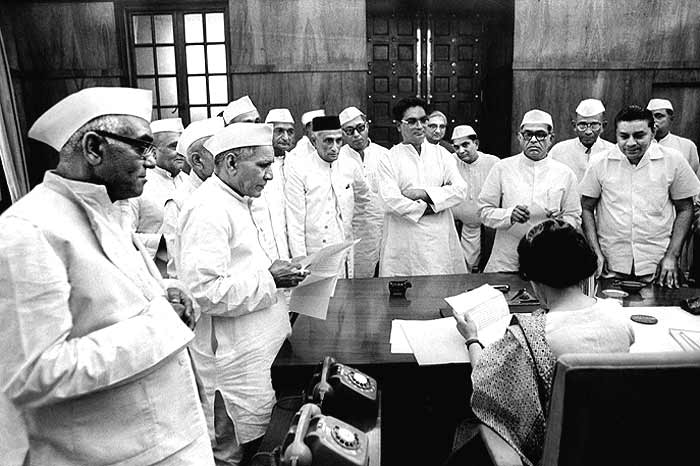
The rising temperatures in the Middle - East has created a febrile situation that is consuming much of diplomatic mind-space in major capitals of the world. The divergent geopolitical strategies pursued by the two most important powers in the region - Saudi Arabia & Iran - has contributed to the tempestuous situation eluding a cogent response to the civil war in Syria & the rise of the ISIS. While Saudi Arabia leads a Sunni coalition & Iran commands a Shia one, understanding the historical genesis of the conflict is crucial to appreciate the current quagmire.
Why the animosity between the Shias & Sunnis?
Sunnis account for about 85% of the 1.6 billion Muslims worldwide while Shias account for a majority of the rest. Shias comprise a majority in Iran, Iraq, Azerbaijan, and Bahrain, and a plurality in Lebanon, while Sunnis make up the majority of more than forty countries from Morocco to Indonesia

Prophet Mohammed gave birth to Islam in 610 AD & before his death in 632 AD, had consolidated the faith in Arabia.  In the fight for succession that followed the Sunnis insisted on Mohammed’s disciple & his father-in-law, Abu Bakr, to be made his successor while the Shias pushed for the dynastic succession of Mohammed’s cousin & his son in Law Ali ibn Abi Talib.

Abu Bakr become the first caliph & was followed soon by 2 others whose authority the Shias rejected; they reject them even today. Reconciliation happened & Ali became caliph in 656 AD but was assassinated 5 years later. His sons, Hassan and Hussein, were denied the right of accession to the caliphate. While Hassan is believed to have been poisoned by Muawiyah, the first caliph (leader of Muslims) of the Umayyad dynasty, his brother, Hussein, was killed on the battlefield along with members of his family, in 680 AD, at Karbala, Iraq, by soldiers of the second Umayyad caliph. The Shias, perhaps feeling betrayed, rejected the caliphates that passed from Arabia to the Umayyad dynasty in Damascus and later the Abbasids in Baghdad.

Sunni - Islam dominated for the first 9 centuries till the establishment of the Safavid dynasty in Persia, in 1501, bolstered the latter by making Shia Islam the state religion, . The Safavids fought the Ottomans - the seat of the Sunni caliphate – for the next 2 centuries enlarging the chasm between the two communities. That continues even today.

The Sykes Picot line
Colonization added another layer to the already existing mess in the region. The Caliphate was abolished post the defeat of the Ottoman Empire, in World War 1 & the territory divided between the victors - France & Britain. Mark Sykes of Britain and François Georges-Picot of France - entrusted the task of segregating territories - did so by drawing a line without paying attention to either ethnic & religious divisions nor to natural
demarcations like rivers & mountains. The ethnic groups of the Middle East - Arabs, Persians, Turks & Kurds - were clubbed together & controlled initially through imperialism & later through dictatorships or royalty. Minorities suffered in the bargain. Kurds the 4th largest ethnic group of the Middle East account for 20% of the population in Turkey & Iraq, 15% in Syria & 10% of Iran but have no independent state of its own – just like the Palestinians. The other end of the spectrum was the usurpation of power by the minorities & maintenance of status-quo through force. Disaster, therefore, was waiting to happen.

Illiberal Minority ruling over a Majority
Iraq’s population of 55% Arab Shia, 18% Arab Sunni, 21% Kurds & 6% others has been ruled by despotic Saddam – a Sunni - between 1979-2003 until the US invasion unseated him & gave the country a Shia Prime Minister Nouri al-Maliki; the lack of inclusive politics by the latter too has balkanised the country into the Kurdish north east, Sunni west & the Shia rest.  ISIS holds the western part of the country along with territory in war ravaged Syria. The situation in Syria, Bahrain & Yemen is no different. The appropriation of power & pelf, in Syria, by people belonging to the Alawi sub sect of Shia Islam invited peaceful protests in 2011 but soon turned violent when the regime led by Bashar al-Assad, proceeded with barbaric suppression.  The US has taken an anti-Assad stand while China & Russia has taken a more pro Assad stand rekindling the re-emergence of another Cold war.

Iran: The rise of Ayatollah Khomeini
Khomeini’s “Islamic revolution” in 1979 marked the overthrow of the US backed Shah of Iran, Mohammed Pahlavi. This sent shock waves through the Middle East royalty;  Khomeini’s support to Shia groups in Lebanon, Iraq, Afghanistan, Bahrain, and Pakistan accentuated this displeasure. The US proceeded by imposing diplomatic sanctions to corner the regime

Iran continued to play its own power games to enhance power in the region. It supports the Shia militia, Hezbollah, in Lebanon, the rebels in Bahrain & the Houthi rebels in Yemen; the rebels in both the cases are fighting the Sunni royal families. Success in Yemen shall give Iran a beachhead to the Red Sea much to Saudi chagrin. This was bound to elicit a Saudi counter.

Saudi Counter
The Saudi royal family, concerned with the growing Shia influence in the region, supported the spread of Wahabism – the most puritanical form of Islam. The growth of Al Qaeda was a consequence of such a policy. They backed the Sunni regime of Saddam Husain, in Iraq, in the 1980–1988 war, with Iran, but withdrew support after he attacked Kuwait. To establish a Sunni influence in Afghanistan they sponsored the Afghan Mujahedeen in their fight against the Soviet Union - that had invaded Afghanistan in 1979 & installed the puppet regime of Najibullah. The US & many Western powers supported the Saudi move & used another predominantly Sunni country, Pakistan, as the conduit to supply arms & ammunition & provide training facilities. Gen Zia-ul-Haq, the then President of Pakistan, in a bid to add muscle to the movement, supported the establishment of madrassas to create fanatical forces; these forces have now started to bite their earlier patrons leading to instability in Pakistan. All countries in the Middle East would like to keep the fanatical forces that they had created, engaged outside their boundaries to maintain stability at home. Needless to say, the chickens are bound to come home to roost sooner or later.

Nevertheless, Riyadh monitors its oil rich eastern provinces – home to a Shia minority - & has deployed a coalition of 10 Sunni majority countries to protect the ruling Sunni royal families of Bahrain & Yemen.  Simultaneously, it offers financial support to the Sunni rebels in Syria while denying the same to Al Qaeda & other extremist organizations to keep the US in good humour. This fine balancing act is unlikely to bring stability to the region.

Terrorist Diaspora
Battle hardened Afghan war veterans of the 1980’s were the core of global terror networks like the Al Qaeda earlier. The volunteers, from Western Countries, post the war in Syria, would return to their homelands, as battle hardened veterans & in the words of FBI director, James B. Comey, can be viewed as a potential “terrorist diaspora”. Indoctrination through social media has made enrolment to terror networks easier & the addition of field experience would create a fearsome war machine with global implications. A co-ordinated approach by all like-minded nations is, therefore, an urgent need.

Redrawing of Boundaries
The cartography bequeathed to the region by British and French colonial authorities is currently getting redrawn. The Assad regime in Syria controls a rump state that extends to the Mediterranean coast connecting with Hezbollah strongholds, threatening the territorial integrity of Lebanon. The Shia axis now extends from Iran to the Mediterranean creating unease in Saudi Arabia.  
ISIS, controls the eastern regions of Syria & western regions of Iraq - a region with vast oil reserves that assures a ready access to finance.  The establishment of the Islamic Caliphate & its expansion plans published alongside, has caused international consternation.
Kurdish groups in northern Syria & their Iraqi cousins are seeking their long denied independence. Yemen -unified in 1990 – could re-fracture along sectarian lines. While most politicians in Iraq, Syria, and Lebanon reject attempts to redraw the map of the region, an existential challenge cannot be denied.
Conclusion

The great power games being played in the Middle East has the potential of creating an unnecessary conflagration. The US is attempting through the P5+1 initiative to reintegrate Iran into the world order clearly realizing that sanctions have had limited effect. Neither Israel nor Saudi Arabia is pleased with such a move. The dipping costs of solar energy & availability of shale gas reserves in the US shall ensure a reduced US & Western interest in the Middle East. The reduction of boots on the ground is only a first step. It is therefore imperative that the Arabs led by Saudi Arabia & the Persians led by Iran cast aside their differences & evolve a security architecture for the region. Else, the region risks of becoming the epicentre of global terror & eventually being reduced to cinders.

Monday, 29 June 2015

The Emergency 1975-77: A Critique

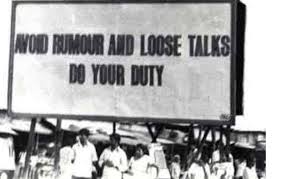
The 40th anniversary of the emergency, in India, on 25th June 2015, was marked by intense debates courtesy L K Advani’s assertion to the “Indian Express” some days earlier that he cannot say with conviction that a similar draconian intervention shall not be repeated. Emergency lasted for 19 months between 25th June 1975 till Jan 1977 when general elections were announced & was finally revoked on 21st Mar 1977 after Indira Gandhi lost the elections; she lost from Rae Bareli while her son Sanjay – credited with most of the excesses during the said period – from neighbouring Amethi. Rumours persist that Indira tried to rig the election results by exerting pressure on the returning officer – the young IAS officer, Vinod Malhotra – as well as influence the army to impose martial law, both of which failed, perhaps, because of the brave professionalism displayed by remarkable individuals representing reputed institutions.

However, not all institutions – designed by the founding fathers of the constitution to create adequate checks & balances – covered themselves with glory during this dark period. The 4th estate – the press – in Advani’s words crawled when it was merely asked to bend. The "Indian Express" & "Himmat" were some of the few exceptions. The Congress’s quest for a “committed judiciary” – in the words of Mohan Kumaramangalam – post the Kesvananda Bharti case led to A N Ray being appointed as the Chief Justice, in 1973, superseding 3 senior judges who were part of the majority judgement. Similarly, post the ADM Jabalpur case or the  habeas corpus case, the dissenting judge, HR Khanna, was punished with supersession. While the incumbent Chief justice then was A N Ray (73-77) the other 3 judges, who were part of the majority judgement - MH Beg (77-78)   Y V Chandrachud (78-85) & PN Bhagwati (85-86) - went on to become Chief Justices during the period 1973-86. Only Bhagwati publicly regretted his 1976 judgement, much later in life.

“Batein kum, Kaam zyada” was the slogan raised by the Congress & punctuality at govt. offices was rigorously implemented. Trains running on time delighted the middle class despite suspension of civil liberties. About 34988 people were arrested under the draconian MISA (Maintenance of internal security) provisions that circumvented the judicial process while another 75818 languished in jails under various Defence of India (DOI) rules; this crushed political opposition since their entire leadership was  incarcerated – a ruthless replication of  the British suppression of the  “quit India” movement in 1942. Mohan Dharia opines that Indira withdrew the Emergency just before submitting her resignation for she feared being arrested under MISA otherwise.

Stories of valour abound. Resistance was offered by some young Turks who occupy the top slots across political parties today. BJP's Sushma Swaraj pleaded the “Baroda Dynamite case” for George Fernandes while her colleague Arun Jaitley - President of the JNU students union in 1974 - was jailed. The current PM Narendra Modi too distinguished himself during this period which explains his meteoric rise thereafter. Leftists who distinguished themselves include CPI(M)’s Prakash Karat & Sitaram Yechury while Lohiaites Lalu Yadav, Mulayam, Sushil Modi & Nitish Kumar cut their political teeth during the said period. Journalist Shekhar Gupta cheekily observes that Indira, therefore, unwittingly, strengthened democracy by helping throw up new talents who were responsible for the Congress’ nemesis in subsequent elections.

Emergency has spawned many literary & cinematic representations. Coomi Kapoor’s “ The Emergency: A personal history”, Kuldip Nayyar’s “The judgement” & “Emergency retold” along with the Justice Shah commission’s report  – whose copies were purportedly destroyed by Indira Gandhi post returning to power in 1980 – give a chilling glimpse of those troubled times.  Salman’s Rushdie’s “Midnight’s Children” has certain sections based on the said period for which Indira did seek a court injunction. If “Garm Hawa” was, perhaps, the best take on the pangs of partition, the 1989 Malayalam movie “Piravi” best epitomized the troubles of the emergency. Piravi is a moving account of a father’s search for the whereabouts of his son who had disappeared during the emergency; critics attribute it as a take on an REC Calicut student Rajan’s disappearance post a purported arrest on the charge of being a Naxalite. Other films like Gulzar’s “Andhi”, Amrit Nahata’s “Kissa Kursi ka”, IS Johar’s “Nasbandi” are also based on the emergency. That begs the question

Why was the Emergency imposed?
Indira Gandhi was convicted by the Allahabad High court on 12nd June 1975 - for electoral fraud perpetuated in 1971 - on a case filed by Raj Narain & argued by Shanti Bhushan – who later held the law ministry portfolio in the Morarji Desai’s govt. She was implicated by Justice Jagmohan Lal Sinha of being guilty on charges of using the state police to build an electoral dais, availing the services of a government officer, Yashpal Kapoor, during the elections before he had resigned from his position, and use of electricity from the state electricity department. Her election was declared null & void & she was debarred from contesting elections for 6 years.

Justice V R Krishna Iyer – a Kerala state minister earleir in the CPI (M) govt. of EMS Namboodiripad (1957-59) & a doyen of civil liberties - on 24 June 1975, upheld the High Court judgement and ordered stoppage of all privileges Gandhi received as an MP. She was debarred from voting but allowed to continue as Prime Minister which meant that she could not take part in parliamentary proceedings. Indira’s
closest advisers then were the Bengal Chief Minister S S Ray, the Congress President Devakanta Barua who famously coined the slogan “India is Indira & Indira is India”, Law Minister HR Gokhale, Mumbai Pradesh Congress Committee President & chief fund collector Rajni Patel & Principal secretary PN Dhar. A paranoid Indira decided, perhaps, under advice from Siddhartha Shankar Ray decided to impose the emergency to continue her hold on power; surprisingly, SS Ray was the first to defect after the Congress defeat in the 1977 elections & deposed against Indira Gandhi before the Shah Commission

RK Dhawan – the secretary to Indira during the said period –claims that Indira in fact wanted to resign post the judgement but was prevailed upon by her cabinet colleagues led by Jagjivan Ram – who later dumped her & joined the opposition - & P N Haksar – later her trenchant critic – prepared the press statement accordingly. He believes that decision to impose the emergency was not triggered by the adverse court judgement but was under consideration from about a year earlier & was later prompted by SS Ray’s letter to Indira in Jan 1975 asking for “drastic action” to control the lawlessness that was spreading across the country. President, Fakhruddin Ali Ahmed, he claims, signed on the proclamation without much prodding. 

Why the lawlessness?
The 1971 Bangladesh war spurred inflation that was accentuated further by the subsequent drought in 1972 & international oil crisis in 1973. This caused resentment amongst the public which triggered the “Navnirman Andolan” (Dec 1973 – Mar 1974), in Gujarat, that catapulted the opposition “Janata Morcha” - a coalition of Congress (o), Jan Sangh, PSP & Lok Dal - to power in that state. The huge corruption allegations in Bihar compelled Jaiprakash Narayan (JP) to call for a “Total Revolution”. George Fernandes led a strike crippling the Railways in May 1974. while. L N Mishra – the influential Minister of Railways in the Central Cabinet was suspiciously killed in a blast at Samastipur, Bihar, in Jan 1975. “Mitrokhin papers” suggest that Mishra - one of the chief fund raisers of the Congress - was accepting money from the KGB. Was he an unfortunate victim of the internal politics within the Congress or was he eliminated as part of the KGB/CIA slugfest on Indian soil is hard to guess.

Clearly winds of change were blowing across the country. India was on the cusp of transitioning from a single party rule to a multiparty one & Indira wanted to stall the shift at any cost. Likewise, the assassination of Allende in Chile, created in Indira, a fear psychosis, that the same fate awaited her, courtesy the machinations of a “foreign hand”. The convergence of all those vectors created grounds for the imposition of the emergency.

The 20 point program announced soon after was chillingly similar to Adolf Hitler's 25 point program announced in 1920 which helped the latter constitutionally seize unbridled power. The "ordinance" raj &  "rule by decree" that followed destroyed the democratic processes that Indira's father, Nehru, so deeply espoused.

The Excesses of the Emergency
The first casualty of the emergency was the then I & B Mininter, IK Gujral, who resigned post being ticked off by Sanjay Gandhi for not carrying a Congress political rally on DD & not couching the Allahabad judgement in a softer language on AIR. VC Shukla replaced him & took censorship to new heights of belligerence. Jagmohan – the head of the Delhi Development Authority (DDA) – applied to himself the epithet “Haussmann of India”- as a reminder of the Frenchman responsible for the transformation of Paris between 1853 & 1870; with the support of Sanjay, he forced the Turkman gate demolitions & compelled the displaced to shift to Trilokpuri, in a bid to beautify Delhi. Sanjay followed through on the sterilization program with gusto which created angst that got reflected in the elections of 1977. Sanjay - as per Ram Guha- was the closest India came to a fascist


In the words of R K Dhawan, Sanjay was influenced by Zail Singh, SC Shukla, ND Tiwari, Gokhale & Bansi Lal to believe that he was in fact more popular than his mother. He therefore became an extra constitutional authority & as per Nirad C Choudhary had the knack of “attracting riffraffs” who were responsible for both the excesses during the emergency; a part of the same brigade were responsible for the 1984 Delhi riots too.

Sanjay mysteriously, wielded enormous power on his mother, the reason still in the realm of speculation. RK Dhawan claims that Sanjay joined politics only post the 1975 supreme court judgement & started organizing rallies in Delhi supported by Mr Jagmohan, then DDA vice-chairman, Mr B R Tamta, then MCD commissioner, and P S Bhinder, then DIG police. They influenced Sanjay to order uniform sign boards on all shops, price tags & demolitions.

Lewis M Simmons’s Washington Post article – released after he was deported from India for penning an article that army officers were unhappy with the imposition of the emergency – accusing Sanjay of slapping Indira, 6 times, at a private party, before the imposition of emergency, spread like “wildfire through word of mouth” as per Coomi Kapoor with the caveat that its authenticity is however doubtful.

Why Did Indira announce elections?
Indira announced elections in 1977, perhaps, convinced by the Intelligence Bureau (IB) that she would secure a comfortable majority. Others argue that burdened by a feeling of guilt for the excesses committed during the emergency, she wanted to make amends. Some critics interpret the accusations of “dictatorship” in India during the Pak elections pained Indira who was conscious of her international image erosion; she took this unexpected decision to protect the legacy of her family - including her illustrious father.

Sanjay was in the dark regarding this decision, some allege, while others believe that he too went by the IB ‘s observation & acquiesced to the decision to formalize power democratically. However, the elections threw up an unexpected result.

Why did the Congress Lose in 1977?
Critics argue that the IB’s analysis of a simple majority was not off the mark when it was made. The opposition was in jail & in disarray while the middle class was largely impressed with punctuality in govt. offices. The twist in the tale happened with leaders like H N Bahuguna, Nandini Satapathy & Jagjivan Ram belonging to the "Congress for Democracy" (CFD) defecting to the opposition ranks just before the elections. The opposition unity under JP – the “Gandhi” of Independent India – triggered a tsunami that washed away the Congress in entire North India; the Vindhyas stopped a congress rout. That begs the question

Why did the Congress sweep the South but was wiped out in the North in elections 1977?
The Akalis under Sant Longowal raised a banner of revolt, against the emergency, in Punjab while the JNU student unions did so in Delhi. Charan Singh charisma ensured victory in the Jat lands of UP, Rajasthan & Haryana.  The RSS played the role of the resistance movement in its bastions - West & North India. The left led the movement in Eastern India. JP's overall leadership of bringing diverse political faces together helped in increasing the index of opposition unity. 

It is alleged that the relentless & reckless implementation of Sanjay’s diktats in North India turned deleterious while the circumspection & candour displayed by Congress CM’s in the South – Devaraj Urs in Karnataka & Jalagam Vengal Rao in AP – helped in voter consolidation. The leaders of the resistance did not have any influence in the South either. Congress(I), therefore, won 41 of the 42 seats in AP & 26 of the 28 seats in Karnataka, 11 of 20 in Kerala & 14 of 39 in Tamil Nadu. Thus south accounted for 92 of the 153 seats won by the congress.  Coincidentally, the south came to the Congress’s rescue in 1989 too, when it was plagued by the Bofors controversy.

In Tamil Nadu, K Karunanidhi’s DMK govt. was dismissed in Jan 1976; he had opposed the emergency. While the "sympathy factor" should have ideally helped the DMK to return back to power, smeared as it was by corruption scandals, it lost the 1977 elections miserably. Had Rajaji or Kamaraj been alive, Congress would have found it difficult to to penetrate Tamil Nadu. The presence of the ADMK as well as the death of stalwarts - Rajaji of the Swatantra Party in 1972 & K Kamaraj of the Congress (O) in 1975 - helped Congress (I) get 14 of the 39 seats in Tamil Nadu.

Conclusion
The emergency is but a grim reminder of what could happen when institutional integrity is compromised at the expense of individual glory. When paranoia combines with megalomania the consequences are generally disastrous.

The excesses by the executive in trying to create a “compliant” judiciary in the 70’s - characterized by supersession of judges - has invited criticism while accusations of “non- transparency” has bogged the judiciary post the 2nd judges case in 1997 - that ruled the supremacy of the collegium over the executive in judicial appointments. Surely a middle ground is called for & hopefully it shall fructify soon. The remarkable judgements in the 2G, CWG, Coal Gate etc. would not have occurred but for an independent judiciary & safeguarding its jurisdiction is, therefore, absolutely essential.

It is critical to strengthen institutions like the Chief Vigilance Commission (CVC), Chief Information Commission (CIC) & the Lokpal. Intriguingly, the positions of the CIC & CVC were not appointed by the NDA govt. for over a year & the Lokpal still remains vacant. Such a lackadaisical attitude by any govt. needs censure.

Only by strengthening institutions & governments being amenable to criticism can India become a “participative democracy” from currently being only a “representative” one. In the words of Tagore “Into such world of freedom let my country India awake”.

Wednesday, 3 June 2015

Movie Review: Welcome to Karachi

The story is about two Indian dimwits who land up in Karachi, inadvertently, & their trials & tribulations of getting themselves extricated, first from the Baloch kidnappers & later FATA militants (Taliban) & the Pakistan Intelligence agencies. The movie loosely based on “Dumb & Dumber” relies on slapstick comedy & stereotyping of characters which might sound offensive to some. The storyline - a spoof on the internal situation of Pakistan - had promise but failed on delivery; it could have done with a spruced up script, better screenplay & editing. The garish graphics are a put off too.

Arshad Warsi (Shammi) is a court marshalled Naval officer implicated for sinking his submarine; his friend  Jacky Bhagnani (Kedar Patel) - the son of a Gujju event manager Dalip Tahil- is intent on going to the land of milk & honey – the US – by hook or by crook but suffers multiple visa rejections because of his idiosyncrasies. Therefore, when Kedar’s father asks them to organize, an event on a cruise ship they decide to use it as a getaway vehicle to reach the US. A comedy of errors ensures & they wander into a cyclone that capsized the boat & sweeps them into the beaches of Karachi – shown as a hotbed of violence. A bomb blast follows & the discovery, on the beach, of Arshad’s wallet - carrying his photo in Indian Naval paraphernalia - invites the attention of the Paki intelligence (ISI) agent Lauren Gottlieb (Shazia) who is soon on his trail assuming him to be the perpetuator.


Shammi & Kedar - shifted to a hospital post the blast - on realization that they are on enemy territory, dress to escape - in stolen clothing – only to be kidnapped by Baloch militia. Arshad dressed as a doc & mistaken for a trained physician - is forced to conduct a delivery, for which he relies on the Raju Hirani’s suction pump trick shown in “3 idiots” to emerge trumps. Later the duo visits the Indian embassy - to secure travel documents – where their indiscretions, yet again, trigger violence between the guards of various embassies. Karachi appears to be a trigger happy city.

They luckily escape the violence only to be kidnapped by Azhar Baloch. Patel’s father - like a good business savvy Gujju - negotiates the ransom for their release. Their interlocutor drops them at a bus stand –a Pathan territory - & reveals the rivalry between Pathans & Balochis; he advises them to collect their passports quietly & return home. Our heroes, in a bid to kill time enter a food stall & get so engrossed in a re telecasted cricket match featuring traditional rivals India & Pakistan that their identity gets revealed, inviting the ire of the Pathans. Arshad Warsi is truly in his elements here.

They flee again only to land into FATA – into Taliban hands - where they are intended to be used as suicide bombers. In a bid to escape from FATA they steal a mobile phone which is actually a detonator & unwittingly, blast the training camp that invites the attention of the American CIA – shown as manipulative & devious – intent on taking credit for destruction of the camp. They agree with the Americans as a quid pro quo for freedom only to land up into the machinations of the Pakistani politicians represented by their Interior Minister Malik who showcases them as patriotic Paki soldiers who have taken on the Taliban while the Indian media reveals their true identity. The cacophony of Indo-Pak debates on the Indian national TV is reproduced here.

Shazia alerts the duo to Malik’s intentions to finish them off – since they had become a diplomatic embarrassment; clearly humanity is not entirely lost on the other side of the border. The CIA rescues & releases them after they agree to grant credit to the CIA for destruction of the Taliban camp. The game of thrones thus completes a full cycle. On their way home at the Karachi airport they spot a Talibani militant dressed as a pilot & with the help of the Paki ISI destroy their plans of a hijack. Or have they?  


Finally Indians & Pakistanis coming together to finish a common enemy – the Taliban – is refreshing. The movie could have been a laughs riot had the direction been more effective; infantile humour was a let-down. Jacky tries desperately to sound Gujju while Arshad – whose repertoire is humour - looks lost. Lauren Gottlieb has a good screen presence & is an outstanding dancer while her acting capability just like her accent is a farce. The director Ashish Mohan gives the movie an abrupt end; perhaps he too had given up. In short watch this movie only if you fail to secure tickets for any other movie.