Showing posts with label Public Policy. Show all posts

Monday, 2 February 2026

Budget 2026-27: Traders Simmer while Data Centres Glitter


Against the backdrop of global geopolitical fragmentation, courtesy “Trumpian Tantrums, Finance Minister Nirmala Sitharaman rose to present her record 9th Budget. The stock market, not always the best barometer, reacted negatively to some parts of her budget speech, which were seen as investor friendly but trader unfriendly, on a Sunday, when FIIs were largely absent from the market. Interest on leveraged trades, which could earlier be set of up to 20% of dividend income, as per Dinesh Kanabar has now been withdrawn. Therefore, how furiously the stock & currency markets would react starting tomorrow is anyone’s guess unless the calming hand of the RBI intervenes or there is a US trade deal.

Following were the expectations from the budget; only some of them, though, were partially met

·         Continue with the path of fiscal consolidation & keep powder dry for deployment when necessary. The Government did not disappoint; announced Fiscal Deficit of 4.4% of GDP for FY 26 & projected a figure of 4.3% for next year.

·         Attract foreign inflows to arrest the fall in the rupee. India’s Net FDI at 0.1% of GDP for FY 25 is at a multi decadal low. Suggestion, by some analysts, to extend the benefit of zero taxation, for investments into infrastructure, currently available for sovereign wealth & pension funds, to endowments went unheeded. Also passed by was a suggestion to reduce Long Term Capital Gains tax for stocks to zero for tenure over 3 years (say), rightly so as Government of India (GOI), appears keen to have similar treatment across asset classes.  STT (Security Transaction Tax) on F&O for stocks was upped, instead, to curb speculation – rightly so, to protect retail investors against algorithmic High Frequency Traders – which, however, spooked the markets. 55% of BSE & 70% of NSE revenues, as per CNBC – is derived from F&O & hence the stock prices of BSE dropped. While SEBI’s recent paper showed that 9 out of 10 people lose money in F&O, questions remain on why STT increases were restricted to stocks alone & not commodities.

·         Rationalization of custom duty slabs from current 8 as was done for GST & an amnesty scheme to unlock 1.5 lakh cr. struck in customs litigations: Custom duties for specific items in strategic sectors like Aviation, Battery & EV & Nuclear power were reduced possibly as Government of India (GOI), negotiating Free Trade Agreement deals with preferred economic unions like EU, may want to retain the negotiating leverage rather than uniformly drop rates for all countries. 

Niti Ayog Chief BVR Subramanyam averred that while focus was on job creation in budget FY 24 & manufacturing in FY 25, the focus of the current budget is “services” – Healthcare, Tourism, Education Sports & Orange economy. Target is to achieve 10% of global services by 2047.

The broad thrust of the fiscally credible budget

·         Nominal revenue growth of 10% for FY 26-27 against 8% this year seen as conservative.

·         Higher than expected gross borrowing of INR 17.2 Lakh crores & the fear of “crowding out” effect thereof, leading to raise in bond yields & consequent marked to market losses impacting banking stocks negatively.

·         It is widely felt that capex as a % of GDP could largely stabilize at around 3%. It is pegged at 12.2 lakh cr. for FY 27.. But announcement of 7 High Speed Rail corridors as “growth connectors” & the Defence Secretary’s statement of expecting 20% growth in Defence budgets over the next 5 years to increase Defence spends to 2.5% of GDP against around 2% now, indicates that we could be up for surprises.

·         India plans to ride the global investment theme of “AI”over the last one year, especially in countries like US, Korea, Taiwan etc. by drawing investments into Data centres by offering a tax holiday, till 2047, to foreign companies providing cloud services outside India using Indian Data centres. Sale to Indian users shall be vide resellers & they will be taxed appropriately. While investments into data centres will flow, as Indian states are offering land & power cheap, will foreign nations not be keen on “data sovereignty”, akin to an Indian demand? Will they be comfortable to allow their data to rest in Indian data centres?

·         As per MeiTY Minister, Ashwini Vaishnav, there are 15L employees in GCC, 25L in EMS & 55L in ITES. Safe Harbour margin of 15.5% for a threshold of 2000cr. for IT services, increase in allocation from 22.9K cr. to 40k cr, for Electronic Component Manufacturing services & Indian Semiconductor Mission (2.0) are meant not only to fortify supply chains but also provide greater employment opportunities.

Conclusion

GOI reduced personal income tax rates & GST rates last year & implementation of the 8th Pay commission recommendations appears the next arrow in their quiver to pump prime the economy to drive consumption. No big bang announcements were, therefore, expected in the budget. Trade deals signed with UK, EU etc will need time to give results as they are yet to be approved by their respective parliaments. In such a volatile & uncertain environment, a fiscally prudent budget was the only option, which was granted.

Sunday, 2 February 2025

A Budget To Boost Consumption By Winning Over the Salaried Class

Finance Minister, Nirmala Sitharaman, rose to present her 8th Budget, on 1st Feb, against the background of a volatile global economy & likely lower global growth in the medium term. There has also been a domestic growth slowdown with the growth rates for FY 25 veering towards 6.4% & firms, in India, complaining of an urban consumption weakness.  Election of “Tariff Trump” as POTUS (President of the United States) & the consequent weakening of the INR – despite RBI’s intervention & depletion of over $50 billion of Reserves - were the other challenges, government of India (GOI) had to grapple with. They had to address the political undercurrent of “victimization” too among the “Middle Class” – largely the salaried ones – which form the core base of the ruling BJP - increasing believing that while the poor get subsidies & the rich tax breaks, bank write offs & concessional Long Term Capital gains - lower than their income tax slabs – while the Middle Class has been left in the lurch. And, finally, fulfil the demands of its BJP party machinery & allies to win the impending state elections in Delhi immediately & Bihar by the year end.

GOI had to respond with a measured action, even while maintaining its reputation of fiscal prudence. Last year, the FM promised a fiscal deficit (FD) glide path of 4.5% in FY26 against 5.6% in FY24 & 4.8% for FY25. FD for FY 26 is proposed at 4.4% with nominal growth predicted at 10.1% against 9.7% for FY25.

Keen to wrest the Delhi state from AAP in the impending state elections, scheduled for 5th Feb, the GOI attempted to achieve both the Policy & Party ask by announcing Nil taxation for incomes up to 12 Lakhs (12.75 Lakhs along with Standard Deduction) lakhs against 7 lakhs earlier. The revenue foregone – 1 Lakh cr. (~2% of the total Expenditure of 50.65 L cr.). One fundamental question raised by the former Head of the PM Economic Advisory Committee Rathin Roy: If Indian GDP per capita is under INR 2 Lakhs, does it make sense to offer Nil tax for 6X that number?

So, what are the Alternatives?

Instead of the reduction in Direct taxes, GOI could have done the following:

1.       Income tax relief benefits around 1 cr. people while a reduction in GST could have benefitted more of the 140crore people. The Centre could have nudged the states too to contribute to the GST drop. That they took the route that they did, clearly was timed for the Delhi elections.

2.       Drop in petrol / diesel rates too was an alternative – although – meddling with market determined rates needing subsidies thereof is always counterproductive.

3.       The Chief Economic Advisor has alluded to the increasing profitability of corporates & therefore the need to increase wages for greater equity.  Firms have taken a stance that rise in wages should not be linked with profitability as they need to raise salaries / wages even when the going is tough. Furthermore, higher profitability was used to pay off debts to banks thereby addressing the “twin balance sheet” problems. The govt. could have nudged a wage rise in farming by increasing the MNREGA rates or by increasing the minimum industrial wage rate. They kept the Industrial lobby happy too by not announcing the same.

4.       On increasing revenues, the govt. had an alternative either to implement a “Tobin tax” – tax those exiting India or increasing the Capital Gains tax or introducing Estate / Inheritance tax. They stayed away from same not to roil the stock market further. Governments of all hues are likely to resist such a temptation fearing the loss of electoral funding.

What then is the game plan of GOI?

While AAP announced free medical treatment, in both Govt. & Private hospitals, for senior citizens, the central govt. announced enhancement of the limit for Tax deduction on Interest from INR 50,000 to INR 1 Lakh for the same segment of the population – albeit spread across the country.

India is facing a structural challenge of Net Household (HH) savings rate dropping to 5.3% a multi decadal low. It is possible that a part of this 1 L cr. – coupled with its multiplier effect, which the former Chief Economic Advisor, KV Subramanian, estimates as 5X - could boost the savings rate, while another part could land up into the stock market or drive consumption, hopefully, driving the virtuous cycle of investment & job creation. 

The 8th Pay commission, appointed by GOI, on 16th Jan 2025, with its report expected by the calendar year end & likely implementation next year has the potential to extend the consumption cycle further; if past history is any guide, we should expect a substantial outperformance of sectors like Consumer Durables next year.

It is possible that the new RBI governor will be nudged to announce a Rate cut soon. 

Specific thrust areas & schemes announced by GOI:

1.       Agriculture: Increase in credit limit from 3 lakhs to 5 lakhs, under the Modified Interest Subvention scheme for the 7.7 cr. beneficiaries including farmers, fishermen & Dairy farmers

2.       MSME: Increase in investment & turnover limits for MSMEs & credit guarantee cover thereof – as 1 cr. registered MSMEs, employing 7.5 cr. people, account for 36% of manufacturing & 45% of exports.

3.       Exports: Focus Product Scheme for Leather & Footwear sectors & attempts to make India a global hub for toys. Exemption of Basic customs duty (BCD) on wet blue leather to facilitate domestic value addition & job creation & crust leather from 20% Export duty announced.

4.       Startups: Looking at the success of the INR 10,000 crore GOI contribution, to a Fund of funds set up in 2014, receiving 91000 crores in commitments received by AIFs for startups, a new fund of fund of INR 10,000 cr. being set up for startups.

5.       R&D: 20K cr. for implementing the private sector led Research, development & Innovation initiatives.

 There is a plan to establish 50,000 Atal Tinkering, over the next 5 years, in schools to inspire the spirit of scientific temper, curiosity & innovation. Also announced were plans to Increase Medical seats by 75,000 over the next 5 years & 6500 seats in 5 IITs set up after 2014. As the no. of govt. jobs keep shrinking & with Large Private corporates showing a greater proclivity for high capex & automation jobs, leading to only a marginal job creation, GOI appears keen to focus on the following for job creation

·         MSMEs

·         Nudge school students towards creativity, higher technical education & then ride the “Startup’ ecosystem to create jobs rather than be a job seeker.

·         Provide a safety net where the principals don’t. As an example, provide benefits under PM Jan Arogya Yogana on registration in the e-Shram portal for the 1 crore gig workers.

The other key takeaways from the Budget

·         Increasing the FDI limit in Insurance from 74% to 100% for those companies that invest their entire premium in India.  While the entry of new global players into the already crowded Indian insurance space is welcome as Insurance penetration stands at 3% only, the immediate stock market reaction was a drop in share prices of listed Insurance players. Was it a reaction to the possibility of increased competition leading to a likely possibility of a drop in earnings or unhappiness at the govt. announcing zero taxation up to 12 lakhs, which allows employees to decide on where to park their savings, unlike the earlier budget announcements of carving out tax breaks for specific investments in Insurance products - (Max of INR 1 Lakh as Health Insurance Premium under Section 80D)?

·         Drop in Petroleum subsidy led to a drop in Oil Marketing Companies share prices.

·         Mission for Aatmanirbharta in pulses & govt promise to procure Urad, Tur Masoor Dal, over the next 4 years from farmers who sign agreements with NAFED & NCCF. This appears to be an attempt to partially address the demand for procurement at MSP by farmers as well as a trial ballon to test the reintroduction of the now withdrawn farm laws.

·         Promise to bring in a framework for sustainable fishing with a specific emphasis on Andaman & Nicobar plus Lakshadweep islands is, perhaps, as much an attempt to increase exports from the current INR 60,000 crore as to use these fishing vessels to protect our strategic interests in the neighbourhood. They could be weaponized as China has done in the South China Sea.

·         Development of 100 GW of Nuclear Power by 2047 with an active participation by the private sector. A Nuclear Energy Mission, for R&D on Small Modular Reactors, with an outlay of 20,000 crore to be set up. This helps expand our renewable energy basket & aids Indian energy security. 

 The Criticisms:

The opposition rapped the Finance-Minister for being kind only on Bihar – with many a largess announced like the establishment of a Makana Board, NIFTEM (National Institute of Food technology Entrepreneurship & Management), enhancement of hostel & other infra at IIT Patna & Patna Airport & setting up a new brownfield airport at Bihta, financial support for the West Koshi canal – during the course of her budget speech. The State goes to the polls by the end of the Calander year.

Replacement of some lowered basic customs tariffs with cess, is in effect stealing what ought to have been legitimately transferred to the states as a matter of right, under the divisible tax pool. Cess collected remains with the centre. 

Growth in capex from the RE of 10.18L cr. for FY 25 to 11.21 L crore for FY 26 (growth of 10.1% similar to the expected nominal GDP growth rate) is unlike the humungous growth rates clocked in FY 23 & FY 24 leading Feedback ventures' Vinayak Chatterjee to question if the govt has moved away from “Capex/Investment led growth model” to a “Consumption led” one. Clearly, GOI has maxed its execution capacity & sane to expect capex growth to merely trend closer to the nominal GDP growth rates henceforth; capex to GDP ratio may stabilize around the 3% mark. The budget expressed an intention to ride the PPP model for which implementation of the Kelkar committee recommendations is essential.

Conclusion:

The budget has the imprint of Modi’s fine political mind. Despite the announcement of a concessional corporate tax of 15%, in 2019, to boost Manufacturing, it still stagnates, unfortunately, at around 15% of GDP against the aim of touching 25% under “Make in India” for the world. Ironically, Personal Income Tax collections have been higher than the corporate tax collections, over the last few years, inviting criticism from the opposition & prompting the salaried class to start believing in the narrative of a “Suit Boot ki Sarkar". The government must have felt a need to erase such a narrative which they did by making the income tax up to the 12 Lakh salary slab zero. While boosting consumption & invigorating the investment & job climate is the headline, winning the Delhi state elections too & finishing off the AAP appears to be the other political objective. Time will tell if the govt. has achieved its twin objectives.


Friday, 2 February 2024

Interim Budget of FY 2024-25: Financially Prudent, Poll Ready sans Fireworks


Finance Minister, Nirmala Sitharaman, presented a surprisingly austere, fiscally prudent, political budget, a vote on account, before the impending general Elections. The less than 1 hour speech, was bereft of big bang announcements, unlike the last interim budget of FY 2019-20, presented by Piyush Goyal, that had the PM Kisan Scheme of Rs 6000 each, benefitting around 12 Crore Indian Farmers & a Tax rebate of Rs 12,500 for the salaried class, earning under Rs 5 lakhs, helping them become “tax Free”. Write off of pending taxes up to Rs 25000, per head, for cases between 1962-2010 & Rs 10,000 for the period 2011-14 was announced, through its impact on polls is difficult to predict; it will help clean the Income Tax books though.

Some announcements for the segments identified by the PM under the Acronym GYAN (Garib, Yuva, Annadata, Nari) - as the focus of this government, as a counter to the caste census demanded by the opposition – was expected but the FM merely reiterated the existing schemes, without adding any new pronouncements.  

It was a “political budget” that promised a White Paper on the mismanagement of the economy prior to 2014, & listed the achievements of the BJP, over the last decade. Expect the white paper to be weaponized during the elections.

A financially prudent budget it definitely was. The Revised Estimate (RE) for the Fiscal Deficit for FY 24 was lower at 5.8% Vs the Budget Estimate (BE) of 5.9% & pegged at a still lower 5.1% for FY 25, in line with achieving the glide path of 4.5% by FY 26 – a prudent macroeconomic strategy against the backdrop of a volatile global environment. The drop in Gross Borrowings, therefore, to 14.1 Lakh crore & Net to 11.75 Lakh crore, to “crowd-in” Private investment, was rewarded by the bond Market, with yields dropping by 10 basis points, akin to a Rate cut & Banks gaining, expecting a Marked to Market (MTM) Treasury gains.  A sovereign ratings upside is not expected, though, as the govt. believes that the International Rating agencies continue to remain biased.

The Govt. may still surprise with off budget announcements:

·         The free food grain scheme for the 80 cr. Garib populace has been extended, for another 5 years, pre-budget - to aid the marginalized suffering from a K shaped recovery.

 ·       In Sept 2023, the Women's Reservation Bill, granting 33% reservation for Nari (Women), in Lok Sabha & State Legislatures was passed by Parliament.

·         Expectation of an inflation adjusted upside announcement for the Annadata (Farmers) from Rs 6000 to Rs 8000 was belied though.

An increase in the capex budget, to a perceived auspicious number of 11.11 lakh cr. (3.4% of GDP), is however welcome ­ - as public expenditures multiples are large - as is the Tax to GDP ratio rise to 18%.  A 1 lakh cr. scheme for rooftop solar, for 1 crore households, to enjoy 300 units of free power per month & sell the excess, thereafter, to the grid, & earn a potential Rs 15000 per annum, which the Secretary TV Somanathan, claimed has a potential to create 1 crore installation & maintenance jobs in principle sounds good in the absence of details, as do the Long-term interest free loans with a corpus of 1 Lakh cr. for funding R&D Budgets. Interest free long term capex loans to states of 1.3 Lakh crores – - an extension of an existing scheme - is, however, welcome, as is the extension of certain sunset clauses. The preferential 15% Manufacturing tax rate, ending on Mar 31st2024 & has, rightly, not been extended, as corporates too cannot seek unending timelines.

The Numbers


 Takeaways:

·         Nominal GDP Growth from 273 Lakh Crores in FY 23 to 297 Lakh crores in FY 24 - a growth of  8.8% & real GDP growth of 7.3% projected - indicates presence of a low inflation deflator. A higher inflation deflator would reduce Real GDP & challenge the "Fastest Growing Large Economy" tag. Tax Revenue grew by 10.7% (1.22 Multiple of Nominal GDP Growth of 8.8%) 

·        A Nominal Growth of 10.5% from 297 lakh crores in FY 24 to 328 Lakh cr. in FY 25 & Tax Revenue growth at 12% - a multiple of 1.15 projected, close to the 1.22 multiple of the previous year - a rational no. against the backdrop of a likely drop in Excise Revenues. In May 2022, Excise Duties on Petrol & Diesel were reduced by Rs 8 & Rs 6 per liter respectively & a further drop as a poll sop, masquerading as an attempt to tame inflation, is not unlikely.  

·         Capital Expenditure as a % of the Budget goes up from 17.6% in FY 23 to 23.6% (Rs 11.11 Lakh Crore) in FY 25 which is welcome.

·         Effective Capital Expenditure has increased to around 31% in FY 25 - about Rs 15 Lakh Crore (11.11 + 3.85 Lakh cr. as Grant in aid for creation of capital). Add the likely 3.5 - 4 lakh crore PSU capital expenditure loads up to an impressive figure of around 18.5 Lakh cr. which is impressive.  

·         Primary Deficit which used to near zero, pre-Pandemic, has moved into positive territory which needs to be addressed.  This could also be since off-balance items have been included in the budget since, leading to more transparency though.

The Concerns


·         India spends 25% of its total Budget of 47.65 Lakh Crores on Interest payments, 16% on Security - 13% on Defense & 3% on Home Ministry - & 2.4% of communications, which are central subjects. While One Rank One Pension (OROP) increased the Defense Pension outgo, the Agni Path scheme, launched in 2022, is an attempt to rationalize the pension payout & lower the median age of the armed forces. Reduction in Central debt, as a % of GDP, & hence interest outgo should be the prime aim of the government, going forward.

·   About 2% of the Budget goes towards civil pensions & 8% towards subsidy. The New Pension Scheme NPS 2004 was an attempt at reducing civil pensions apart coupled with the steady decrease in central government & PSU employment since 1996.

·      With around 31% of Budget as Effective Capital Expenditure & with 53% across the aforementioned items, leaves only around 16% for all other Ministries, nullifying the oft repeated argument that the size of Govt. is large.  In fact, India needs greater state capacity even as we refrain from creating white elephants.  The example set by Government of Singapore is a good template to follow.

Furthermore:


 ·         In a volatile Northern & Western border scenario & with China’s India encirclement encompassing Maldives too, the dip in the Defense Expenditure is inexplicable.

·         While weeding out bogus beneficiaries to rationalize subsidy is always welcome, the steep drop in nos. for 2 consecutive years, is troubling, as rural distress is palpable with the ill effects of El Nino & the increase in the no. of people dependent in Farming increasing from 20 cr. in 2019 to 24 cr. in 2021 due to the pandemic, impacting incomes.

Conclusion:

Nirmala Sitharaman, equaled Morarji Desai’s record of presenting 6 consecutive budgets & shall be remembered for launching the 15% preferential Tax on Manufacturing & reducing corporate taxes to a competitive 22%, in 2019. Both were off Budget announcements & those who aver that her interim budget lacks “fireworks” should not be surprised if the aforementioned trend continues.

Launch of the Production Linked Incentive (PLI) Scheme in 2020 & bringing in off budget items into the General Budget, during the Pandemic Times, when Fiscal Deficits of all countries worldwide were rising - and Rating Agencies were looking away - timed in greater transparency. Her latest Interim Budget sans fireworks is definitely “financially prudent” as a “Vote on Account” ought to be.

Sunday, 29 August 2021

What Military Reforms does India Need?


India witnessed an, avoidable, ugly verbal public spat between the Indian Chief of Defence Staff (CDS) – General Bipin Rawat & the Indian Air Force (IAF) Chief RKS Bhadauria, in July, 2021. General Rawat who hails from the Indian Army said ”The air force continues to remain a supporting arm to the armed force. Just as artillery & engineers support the combatant arms of the army”; the Air Chief disagreed with a subordinate role for the Air force. The CDS is expected to be an impartial arbitrator while designing the “Integrated Theatre Command” operational structure & the aforementioned statement was best avoided. No wonder, while the US introduced Theatre operations in 1986, Russia in 2008, China in 2013, it is still work in progress in India, with each wing, of our armed forces, unfortunately, busy protecting its own turf.

There is also the problem of the Infantry division within the army playing “big brother” to the artillery & armour divisions.  Both India & the US have a similar Armed forces strength of 14 lakhs; while the former - a global power, understandably,  has 41% of its manpower in the Navy + Marine core, India, a regional power, had disproportionate manpower locked in the Army at 83%.

Nos in Lakhs

India

US

Army

12

83%

4.9

35%

Navy

0.55

4%

3.36

24%

Marine Core


0%

1.96

14%

Coast Guard

0.2

1%

0.42

3%

Air Force

1.7

12%

3.36

24%

Armed Forces

14.45

100%

14

100%

 US data from Council of Foreign Relations https://www.cfr.org/backgrounder/demographics-us-military

In 2015, neighbouring China initiated Military reforms & its army, today, accounts for less than 50% of the total armed forces size of 21.85 Lakhs & further rationalization is underway. Contrast that with the Indian response of increasing the size of its Army, after the Chinese ingress at Depsang, in 2013. Ingressions continued at Chumar in 2014, Doklam in 2017, & Galwan, Gogra, Hot Springs, & Pangong Pso in 2020.

Should India reduce the size of its army?

(1)Indian Army accounts for 55 -57% of overall Defence spends. Russia which has a land border of 20,241 Kms, defends it using a 3.5 lakh strong Army, while India, having a smaller 15200 Kms land border, has an army over 12 lakhs.

Rs (Crores)

2017-18

2018-18 RE

2019-20(BE)

2017-18

2018-18 RE

2019-20(BE)

Army

154655.2

156628.1

166379.8

56.7%

55.5%

55.1%

Navy

38833.63

41685.91

45368.14

14.2%

14.8%

15.0%

Airforce

62310.79

63875.6

68948.88

22.9%

22.6%

22.8%

DGOF

650.85

1276.5

934.63

0.2%

0.5%

0.3%

DGQA

905.76

1023.79

1213.66

0.3%

0.4%

0.4%

R&D

15203.04

17610.38

19021.02

5.6%

6.2%

6.3%

Total

272559.3

282100.2

301866.1

100.0%

100.0%

100.0%

DGOF

Director General of Quality Assurance

DGQA

Director General of Ordnance factories

R&D

Research & Development

From the Ministry of Defence Annual Report Page 16

These figs include Revenue plus Capital Expenditure; excludes pensions & Ministry of Defence (MoD) expenses.

The argument that India lies in a troubled neighbourhood with both Pakistan & China as foes, might not hold as Russia too is logged in a fight with Japan in the East, NATO (North Atlantic Treaty Organization) in the West &an unstable Central Asia & Caucasus in its South West backyard.

(2)India spends 26% of Defence budget on pensions; rationalization of manpower can help reduce pension outgo. Equip a leaner force better & invest disproportionately on technology for greater bang for the buck.


2017-18

2018-18 RE

2019-20(BE)

2017-18

2018-18 RE

2019-20(BE)

MoD(Misc.)

15144.57

16318.48

17065.12

4%

4%

4%

Revenue Expenditure

182121.42

188118.1

198485.76

48%

46%

46%

Capital Expenditure

90438.39

93982.13

103380.34

24%

23%

24%

Pensions

91999.58

106775.14

112079.57

24%

26%

26%

Total

379703.96

405193.85

431010.79

100%

100%

100%

From the Ministry of Defence Annual Report Page 16

RE: Revised estimate

BE: Budget estimate

MoD: Ministry of Defence


(3)As per a Rand Corporation report, Russian spends on Navy & Air force are higher than Army; likewise, the 17% spend on Aerospace Defence forces (Merged with the Air Force in 2015) – which operates Russian Military satellites & Plesetsk cosmodrome – indicates a disproportionate focus on “asymmetric warfare” away from conventional theatres of land & water for competitive advantage - a strategy India ought to copy.

Russia (Rand Corporation Report 2019)

% of Defence expenditure

Army

15%

Navy

25%

Air Force

24%

Strategic Missile Forces

5%

Aerospace Defence Forces

17%

Others & Multiservice

14%


China too has launched the “Rocket force” – to manage strategic missile operations - & “Strategic Support Force” – for managing the Cyber, Space, electronic & Psychological warfare, as part of Military reforms.

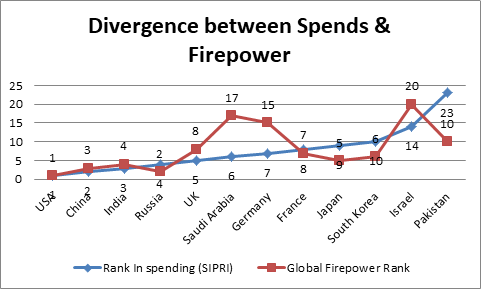
(4)As per the Stockholm International Peace Research Institute, while India spends $72.9 billion, 2.9% of GDP, on defence – the 3rd largest in the world – against China (1.7% of GDP), UK (2.2%), and France (2.1%). Saudi Arabia’s disastrous performance in the Yemen conflict despite spending 8.4% of GDP indicates that higher spends does not necessarily lead to better outcomes. Saudi is also the largest arms importer in the world – a sordid record which it shares with India – indicating the need for a better strategy, including indigenization.


(4)While Russia spends $61 billion – the 4th highest in the world - less than India’s $72.9 billion, it is rated the 2nd biggest in firepower behind the leader - the US.


Russia has been accused of interfering in the elections of EU (European Union) nations & the US – a reflection of his "cyber" capabilities & the ability of its intelligence agencies to penetrate political parties in other nations to run “influence” operations. Its “Aerospace Defence Forces” & “Missile Defence Forces” that provide additional teeth have been mentioned earlier. Despite Russia spending less than India, none dare attack the country, fearing a deadly reprisal consequent to its technological superiority. Replication of the Russian playbook a sane strategy – more so since they have been grandmasters of diplomatic chess.

The evolution of war:

Alexander, in the 4th Century BC, led land forces in his world domination sojourn; with improvement in ship building activities, over the last millennium, launch of naval forces followed which aided colonization activities of countries like Portugal, Spain, England, France, Holland etc. Wright brothers flew the first Aeroplane in 1903 & by WW I airforces made their entry.

World War II saw armour innovation in the form of German Panzer Tanks & their famed "blitzkrieg" strategy. The theatre of war evolved & the US, surprisingly, won the 1991 Gulf war, against Iraq, in days - unlike the "mother of all wars" that Saddam Hussain promised  - due to its “air power” & “network centric warfare”. The recent Azerbaijan victory over Armenia, in Oct -Nov 2020, was on account of cleverly using drone warfare; in the 1991 & 2020 conflicts tanks looked like sitting ducks. It is likely, that Future wars shall be fought, from afar, without soldiers needing to cross their national borders.

Israel bombed Iran's nuclear facility via an airforce strike in 1981; circa 2010, it disabled 1000 of the 5000 centrifuges to derail production of enriched uranium, needed to make a nuclear bomb - a process repeated again in 2020-2021 revealing its Israeli strides in Cyber warfare. Closer home, in 2020, a cyber-security breach, attributed to the North Korean group Lazarus, was detected at India’s Kudankulam nuclear reactors, perhaps to steal thorium based nuclear reactor technology that India is developing.

As per the Maharashtra Energy Minister, Nitin Raut, the Oct 12 2020 Mumbai power outage suggested a possible cyber-attack traced to malware from China, UK & other places; he announced ban on Chinese equipment henceforth. These incidents could be linked to the Indo-China Ladakh clash which as per a New York Times report quoting a Cyber security firm "Recorded Future": “a message from Beijing about what might happen if India pushed its border claims too vigorously”

Similarly, the forced shut down of the National Stock Exchange on Feb 24th 2021, surprisingly, due to simultaneous glitches detected in the leased lines provided by both the Telecom providers, evokes suspicions of a “foreign hand”.

It is surprising how an IT superpower like India has less than adequate Cyber warfare capabilities.

Stunned by the Chinese Anti satellite(ASAT) weapon Test in 2007, India as per Ashley Tellis, in a Carnegie Endowment for International peace, article titled “India’s ASAT Test – An Incomplete Success” on April 15th 2019, conducted a similar hit in Feb 2019 while failed but achieved success later in Mar 2019. He warns however that China has surged ahead beyond lethal ascent interceptors or co-orbital attack satellites - with a potential to produce debris & consequent international condemnation as it affects other orbiting satellites, even of friendly nations too - to use of advanced ground based directed energy weapons – lasers or high power microwave systems as alternatives. Low energy lasers can damage the electro optical or infrared sensors effective against most of Indian satellites in low earth orbit.  Ground based high energy lasers or space based microwave systems can permanently destroy the electronic circuitry of systems without creating unwanted debris associated with a physical collision. China is pursuing co-orbital service satellites that manipulate their trajectory or physically damage them by mechanical means - such as robotic arms rendering the spacecraft inutile to its possessors. China has the capability to target India’s master control facilities – other nodes in its telemetry, tracking & control network – through both space based jamming & precision air & missile strikes or destroy space platforms through high altitude nuclear explosions. China has been developing “asymmetric” counter space technologies to target US operational dependencies, which their strategists believe reside in inordinate reliance on space for their conventional military success. India must therefore develop an effective space situational awareness & operationally responsive emergency space launch capabilities, space deterrence strategy & space doctrine, he concludes.

Conclusion

The theatre of war has evolved into the Cyber, Space, Electronic & Psychological warfare domains, while India is still reliant on a manpower centric army accounting for 83% of the total armed forces of 14.45 lakhs. The Global superpower, US, meanwhile, only has a 14 lakh armed forces of which Army is 4.9 lakhs (35%) only; the corresponding figures for Russia are 10.14 lakhs & 3.5 lakhs (34.5%) respectively.  Russia, like India, is located in a troubled neighbourhood but spends only 15% of its Defence budget on the Army while we spend about 55%. Our pension expenses are  about 26% of the total Defence expenditure & reduction of army's manpower shall aid its control.

The US – India –Japan – Australia –  Quad grouping is largely a "Maritime partnership" which needs India to enhance its Naval spends to at least 25% of the defence budget, against 15% now, just like Russia. Focus on submarines, some of them permanently deployed in the South China Sea, shall be the key.

An IT superpower like India should quickly enhance its cyber warfare capability through greater university & private sector connect. ISRO’s (Indian Space Research Organization) success should be used to lure brilliant minds into space research & creation of Anti-satellite ASAT weapon systems using laser, microwave & robotic technologies. Creation of “asymmetric warfare” techniques rather than investment on higher manpower is critical to enforce deterrence.

Rationalization of the army to remove fear in the Navy & Airforce of being swamped by the much larger Army, in the proposed “joint theatre commands” might be a preferred option.  It is important to first get our Joint Forces doctrine out, reduce the size of the army, enhance the size of the navy, and build our Cyber, Space,  Electronic & Psychological warfare capabilities before shifting to the joint theatre command structure.