Wednesday, 20 July 2022

Indian Telecom Trends 2022


A brutal predatory price war, in 2016, aided arguably by a biased regulator, led to the Telecom Industry consolidation. The number of operators in India’s thriving Telecom sector shrank from 12 to 4 – Airtel, Vodafone – Idea (VI), Reliance Jio & state run BSNL – MTNL. The Supreme Court judgement on Adjusted Gross Revenues (AGR) forced the promoters of VI – Britain based Vodafone Plc. & Kumar Mangalam Birla – to throw in the towel, triggering a state mounted rescue – with Government of India (GOI) taking a 33% stake in VI in lieu of Rs 16100 cr. – a part of pending dues. This has, in effect, reduced the industry to 2  telcos – completely in the private sector – along with other private players like Tata Tele Business services that now offer only enterprise services - post selling their mobility vertical to Airtel.  Increased NPAs (Non Performing Assets) of the Indian Banking sector was the natural collateral damage lost in the din of consumer delight while enjoying low cost data. The debilitating price war in the sector has since ended, leading to a welcome rise in ARPUs (Average Revenue Per User), but the following trends could impact the revival of the sector, especially when rewards in digital advertising, e-Health & Mobile education are a slow burn.

(1)Clash between Technology Firms & Traditional Telecom Service Providers (TSPs) :  Indian Cabinet Approval, in June, for the setting up of private captive networks, to spur innovations in Industry 4.0 applications in M2M (Machine to Machine communications), IoT (Internet of Things), Artificial Intelligence (AI) across Auto, Agriculture, Healthcare, Energy & other sectors, invited the ire of the TSPs. This appears to have been prompted by Broadband India Forum (BIF) -  boasting of members such as TCS, Cisco, Google, Facebook, Qualcomm, Intel  etc. & interestingly Indus Towers & One Web owned by Airtel  as members. However, “administrative allocation of spectrum” has been opposed by COAI (Cellular Operators Association of India) with TSPs (Airtel, Jio & VI)  as members, as it goes against the principle of a “level playing field” – offering, effectively, a back door entry to technology players to provide 5G services & solutions without regulatory compliance & levies, otherwise paid by the TSPs. This would diminish revenues, affecting the business case of 5G, they allege. They are against “direct spectrum allocation” to System Integrators & intermediaries as it runs the risk of spectrum fragmentation, viability of the 5G business case, apart from having serious national security implications.

BIF’s President T V Ramachandran lambasted the ‘level playing field demand” & averred that “no mature regulator in the world imposed regulation on a player with no or minimal market share” as they cannot abuse their position as private 5G networks are for “self consumption” alone – will not sell services or earn revenues. Tech Mahindra’s CP Gurnani opined that if GOI wants to make ‘ the country more technology competitive, more productive & citizen service oriented, they should give it (spectrum) free for a few years” & enterprises – hospitals, factories to Industrial townships - should be free to go to any service provider –TSPs or Technology companies - & ‘not pay any licence fees”. Manufacturing, auto, oil & gas sector are extremely bullish on adoption of private networks worldwide he added & argued in favour of disintermediation by eliminating the TSP layer

It is a fact though that launch of “private 5G networks” would lead to the drop in revenues of existing TSPs, translating into a drop in revenues to GOI who earns a fixed % as revenue share. Why is GOI making such a move?; Is it an attempt  to prompt TSPs to bid higher in the impending spectrum auctions – leading to higher GOI revenues - & accelerating the launch of 5G – which the, otherwise, debt strained TSPs would have liked to be pushed down the road?

(2)Entry of New Players: Adani, meanwhile, surprisingly, has thrown its hat into the ring of spectrum auctions, scheduled for 26th July 2022, instead of opting for the cheaper option of securing a direct assigned spectrum, without paying any license fee & entry fee, under the “captive non-public network (CNPN) category. COAI welcomed the move. Adani Data Networks – a 100% subsidiary of Adani Enterprises - that incubates new businesses – has secured a letter of intent (LOI) by Department of Telecommunications (DOT) for granting Unified access license with authorization of National Long Distance (NLD) & International Long Distance (ILD)for & Internet service Provider - ISP (B) for the Gujarat circle. Under ISP (A), a company can operate in all the 22 circles across the country while under ISP (C) licence they can operate in a part of a circle. The company has data centres across the county & is currently paying TSPs “carrier charges” which it could potentially save by launching its own services & create an additional revenue stream by carrying the data & voice traffic of other Telcos & enterprises.

Bank of America opines that lacklustre ROI, inadequate spectrum, low potential for differentiation & low tariffs could render infructuous any business case for a non 4G player in consumer mobility.  Having already entered into a definitive agreement to acquire Cement maker Holcim’s stake in ACC & Ambuja Cements at $10.5 billion deal, Adani is unlikely to make a bid for the beleaguered VI, especially with Telecom ARPU’s trending around $2 only. Adani press statement which reads ““We are participating in the 5G spectrum auction to provide private network solutions along with enhanced cyber-security in the airport, ports and logistics, power generation, transmission, distribution, and various manufacturing operations.” helped clear the airs of speculation. As against an Earnest Money Deposit (EMD) of Jio (Rs14000 cr.), Airtel (5500 cr. ) & VI (2200 cr.), Adani at Rs 100 cr. only signalled limited bidding.

During the last Spectrum auctions, in Mar 21, EMD of Rs 13475 cr. attracted bids Rs 77815 cr. (5.77X); as per an Economic Times Now )report, the multiple in generally 5 -6 X. We can therefore expect bids this year with EMD of Rs 21800 to be in the 1 - 1.25 lakh cr. range.

While 72GHZ of spectrum in the low frequency (600, 700, 800, 900, 1800, 2100, 2300, 2500 MHZ), mid frequency C Band (3.3-3.67 GHZ) & High frequency (26GHZ) are up for auctions for a 20 year tenure, the greatest interest would be focussed on the mid frequency as most of the 5G ecosystem has developed around the same apart from the 26 GHZ airways used for the captive private networks – priced low at Rs 7 cr. per MHZ for pan India spectrum; 700 MHz, albeit costly, grants better coverage. Lower frequencies are used for “coverage”, with TSPs progressively using graded frequencies up the spectrum for “capacity”. Payment of zero Spectrum Usage Charge (SUC), on spectrum acquired in the impending auctions, provides a significant relief to the industry.

(3)Government of India (GOI) Targets Chinese Companies: Chinese companies, ZTE & Huawei, are still to secure the “Trusted sources” tag – a mandatory requirement for supply of network equipment; their Indian, US & European counterparts, meanwhile, have secured the same, pushing Chinese companies out of contention on supplying 5G gear to telcos The offices of Huawei were searched in Feb & Huawei in Aug 2021 by the Tax authorities on suspicion of tax evasion. Furthermore, GOI issued a lookout notice on Huawei India Chief Li Xiongwei, in May 2022, which prevented him from flying out to Bangkok to attend a business meeting. These steps allude to a decisive move, by GOI, at decoupling to protect “security” interests. Chinese handset manufacturer – Xioami, Oppo Mobiles, etc. enjoying a dominant markets share, in India, too are facing similar pressures; they have been served notices by the IT department for custom duty evasion, non addition of “ royalty & license fees” in the transaction value of imports & inflated payments against receipt of technical services from related parties outside India.

Telcos are falling in line with govt. policy despite initial murmurs of protest, on increased consumer prices, consequent to replacement of cutting edge Chinese gear with costlier western products. GOI has banned Chinese apps but not Chinese gear but regulatory barriers could serve the purpose. Chinese gear is, however, blocked in US, UK & Sweden & Canada has accused Chinese firms of spying. In Nov 2021 the US Federal Communication Commission (FCC) revoked the licence of China Telecom to provide telco services on security concerns, continuing with their March 2021 decision to revoke authority to 3 other Chinese firms -  China Unicom, Pacific Networks & ComNet & disapproval, in 2019,  of China Mobile’s application, in provide telecom services between the US & foreign destinations.

(4)Telecom Signal interference with Aircraft Altimeters & Telescopes: Airlines for America & Aerospace Industries Association,  in Jan 2022, complained that the  FCC has failed to explain why it rejected the “detrimental impact of interference” of the C band 3.7GHz licences on radio altimeters. They are not seeking a full stop of new 5G services but only a stay on roll out in designated locations at 135 airports. “Airlines will not be able to rely on radio altimeters for numerous flight procedures & thus will not be able to land at certain airports” its filing read. Cellular Telecommunications Industry Association (CTIA), however, debunked the complaint & alluded to 5G operating safely in over 40 countries without harmful interference & FCC rejection of interference claims 2 years ago after exhaustive review.

Meanwhile, in India, Giant Meter wave Radio Telescope (GMRT) Pune, a project of the Department of Atomic Energy, operates in the 100 -1500 MHz frequency bandwidth has been complaining of signal interference from telecom towers operating in the 800-900 MHz band corrupting data quality. The solution is to operate the towers, within the GMRT protection zone, in the 1800 MHz band.

Conclusion:

The revival in the telecom sector’s fortunes, via consolidation, would be impacted by the entry of new players like Adani – in case they decide to enter into the consumer space unlike captive private networks alone; their $10.5 billion bid for Cement Maker Holcim’s Indian assets could restrict their Telecom ambitions in the near term. VI though, continues to remain an acquisition target. The Cabinet approval for the administrative allocation of spectrum, based on likely intense lobbying by the BIF members like TCS, L&T, Google, Amazon etc. has the potential of reducing govt. revenues, if processed; the announcement appears more an attempt to spur, an otherwise, recalcitrant TSPs, burdened by a huge debt overhang, delaying 5G rollout, to act quickly, to protect their turfs & deny space to Tech firms.  

Sino-Indian decoupling of telecom gear, by denying “trusted sources tag” to Chinese manufacturers like Huawei & ZTE is, perhaps, work in progress, with India collaborating with its Western counterparts. But since gear from western players too comes with its own Trojan horses, “atmanirbharta” in gear manufacture, courtesy the PLI (Production Linked Incentive) scheme, is the new forward.


References

https://www.theweek.in/news/biz-tech/2022/07/14/telecom-companies-say-allowing-captive-networks-will-make-their-5g-rollout-unviable.html

https://www.bloomberg.com/opinion/articles/2022-07-13/gautam-adani-gets-into-india-s-telecom-sector-the-realm-of-rival-mukesh-ambani

https://trak.in/tags/business/2022/07/15/adani-group-will-launch-telecom-services-from-this-state-5g-will-be-the-foundation/

https://www.fiercewireless.com/regulatory/china-bites-back-after-fcc-china-telecom-order

https://www.fiercewireless.com/wireless/airlines-file-emergency-petition-stop-5g-c-band-deployment-near-airports

https://indianexpress.com/article/cities/pune/now-gmrt-faces-signal-interference-from-airtel-and-other-telecom-operators-8034043/


Sunday, 1 May 2022

Cinema & Migration - Agents of National Integration Across the Vindhyas

Oh, East is East. West is West & Never the Twain shall meet.                  Rudyard Kipling


The above line, borrowed from a Rudyard Kipling poem - alludes to the apparent lack of harmoniousness & agreeability between East & West. The success of South movies RRR & KGF in the Indian Northern belt & the unfortunate debate it has triggered, courtesy the Ajay Devgn – Sudeep twitter spat,  if Hindi is our “national language” indicate that “East” & “West” could very well have been replaced by “North” & “South” with the same outcome. The ever controversial Kangana Renault weighed in on the language debate by proposing Sanskrit as the national language – which, i am personally inclined to agree, because of the following reasons:

(a)While Hindi as a National language, in Devanagiri script, gives a disproportionate advantage to those whose mother tongue is “Hindi’, Sanskrit would have forced all the Indian citizens to learn a new language & script. In our constitutional debates, Nehru proposed Hindi in Roman script – as German is written too – as a compromise which was, however, torpedoed by people like PD Tandon, who insisted on the Devanagiri script, deepening the North-South fault-lines. By 1965, Hindi was supposed to replace the official languages as the national language, but consequent to the simmering angst, violent protests erupted & a non-Congress DMK government was sworn to power in Tamil Nadu in 1967.

(b)Sanskrit, a pronto Indo- European language, would, perhaps, help India into an Eurasian embrace – in line with our Global ambitions - as well as enhance research into our cultural past. Continuance of English shall help in sustaining our relationships with the large English speaking Western world, sustain our dominance in fields like IT & help enhance our labour force exports in fields like healthcare, education etc. – extremely important in a scenario where India is on its way to beat China & emerge as the most populous country in the world but with jobs growth not keeping pace with population growth.

Even if Sanskrit is accepted as the national language, there would be a debate in what script it should be taught. A logical, though unlikely compromise would be for people to learn it in their mother tongue; a Tamilian learns Sanskrit in the Tamil script while a North Indian can do so in Hindi, Gurumukhi, Sharda etc.

This brings us to the next question:

Shouldn’t PAN Indian movies spur greater National Integration?

There was a time when ignorance was bliss: North Indians clubbed all people South of the Vindhyas as “Madrasis” despite the presence of distinct identity & many spoken languages – Tamil, Telugu, Kannada, Malayalam, Tulu, etc.  just as South Indians clubbed all North Indians as “Hindi” speakers despite the presence of Punjabi, Bhogpuri, Maithili, Kashmiri etc., Doordarshan, since 1980’s, did a yeoman’s job of nudging a better cultural understanding via their national transmission of regional cinema, with subtitles, in the Sunday afternoon show; the dubbed versions, telecast via satellite channels, since the 2000’s has aided in better understanding & appreciation. Enhanced migration to the South, over the last 2 decades, because of the IT boom, appears to have accelerated the cycle.

Earlier, while south Indian heroines from Waheeda Rehman, Vyajantimala etc, in the 1950’s & 1960’s to Jayaprada, Sridevi, Rekha etc. in the 1970’s to 1990’s wooed the North Indian audiences, south Indian heroes’ rarely made a big impression beyond auteurs like Kamal Haasan, Rajnikanth, Nagarjuna etc.; critics attributed the popularity of heroines to their training in choreography & the lack of heros’ acceptance to their plumper physiques & moustachioed countenances -unlike their north Indian counterparts. But over the last 3 decades North Indian heroines, like Kushboo, Tamanna Bhatia etc.  have become extremely popular in the south while South Indian heroes like Allu Arjun, Prabhas, Yash, Vijay etc. have become North Indian household names, largely attributed to the super success of South Indian Movies like RRR now, following in the footsteps of Pushpa, KGF or Bahubali earlier; covid & the subsequent OTT boom of channels like Amzaon Prime, Netflix etc. exposed Indian audiences to regional cinema enhancing understanding & appreciation.

Films are now being mounted in a grand scale & released at least in the 4 south Indian languages & Hindi, heralding the era of “Pan Indian” films, truly a harbinger of tighter national integration.

How we defeated the prediction of an Indian Disintegration

Many geopolitical tsars predicted the inevitable breakdown of the Indian republic, post-independence, considering the diversity of over 1652 languages, 8 religions & 3 races; India was akin to continental Europe with different nations they reasoned. From a culture, cuisine, language, dress code & way of life point of view Indian Punjab was similar to Pakistani Punjab, across the border, much like the similarity of Indian Bengal with neighbouring Bangladesh. While the “Aryan” region -extending from Punjab to Bengal - spoke the proto Indo – European languages, that accorded a distant familiarity, the “Dravidian’ South, spoke a different tongue, leading to the identification of a schism. Some historians pointed to South Indian dynasties like the Cholas, Cheras, Pallavas, Pandhyas etc. retaining their distinct identity, even during the days of the Pataliputra (current day Patna) centric Mauryan or Gupta empires or the Delhi based Mughal empires later to buttress their arguments. The anti-Hindi agitation & demands for a separate Dravidistan, by the DMK, post-independence, appeared temporarily to eerily fulfil their predictions.  But, India has not only survived but thrived & the naysayers had to eat humble; surprisingly, continental Europe too created the European Union (EU), accepting diversity & using inclusivity as a tool to maintain peace in a land, otherwise ravaged by the World wars. The Indian model appears to be gaining traction.

While the Sino-Indian conflict of 1962, triggered a “nationalism” induced integration, the recent genetic studies have helped in reducing the “Aryan” & “Dravidian” divide as both emerged from the common pool of “South Asian Hunter gathers” (SAHG) – the original inhabitants of India; SAHG mixed with Iranian agriculturalists to form the Indus Valley Civilization (IVC). IVC natives mixed with the invading Aryans to form the ANI (Ancestral North Indians” while the retreating IVC inmates mixed with the SAHG to form the ASI (Ancestral South Indians)

Post-independence, better physical infrastructure, communication & urbanization triggered mobility, among the populace, in pursuance of aspirational education & job opportunities. The shift appears to have happened in the following phases:

(a)Migration of people working for the central government & In PSUs (Public Sector Undertakings); private sector in Gujarat & Maharashtra attracted workers into manufacturing

(b)Focus of the 2nd Five year plan (1956-61) on heavy industry & the creation of Steel plants & cosmopolitan townships in Rourkela, Durgapur, Bhilai, Bokaro etc.

(C)Bank nationalization in 1969 & mobility of the national cadre

(d)IT boom in the 1990s & migration towards the Southern cities of Bangalore, Hyderabad & Chennai.

South Indian states of Kerala, Karnataka, Telangana, AP & TN account for 30% of Indian GDP, but only 20.7% of Indian population, while & the corresponding figs. for West (MP, Goa & Gujarat) being 22%  & 15.5% respectively. Thus the South & West account for 52% of Indian GDP, 64% of Manufacturing but host only 36% of population. Not surprisingly, as per the 2011 census, of the Indian population of 121 crores, 45 crores are internal migrants – including people who have moved within a state’s geography; 4% (5.4 cr.) are inter- state migrants. Chinmay Tumbe, IIM Ahmedabad, in a Mint article avers that traditionally, while Delhi & Mumbai were migrant magnets, especially from UP-Bihar-Bengal belt, the 2011 census has shown the Southern states to be the new magnet; migrants as a % of Urban workforce are 24% in Mumbai but below 15% in Bangalore, Chennai & Hyderabad but the 2021 census could throw up a higher fig..

Migration led to better appreciation of language & cuisine; Idly, dosa, vada, Sambhar, Hyderabadi biryani etc. from the south were exported to the north while Punjabi tandoori cuisine rushed south; North Indians now try out Kerala appam or TN’s Chettinad foods, Karnataka’s Besibelli bath or Andhra’s chutneys like aavakaya (mango pickle) or Gongura mixes; food at AP Bhavan is a big draw in Delhi. That people are debating the taste of the Hyderabadi, Avadhi & the Bengal versions of Biryani aids the cause of national integration. South Indian coffee has travelled North via chains like CafĂ© Coffee Day, Barista etc. while Hot Tea shops, primarily a North Indian retail landscape phenomenon, have travelled south. 

Rasagollos rushed from the East to flood the country’s taste buds just as Maharashtra’s Vada Pav is found in various forms across the country, coexisting with the imported Burger version - popularized by the likes of McDonalds.  Dhabas adjacent to highways, serving as motels for truck drivers, have played a major role in cuisine appreciation. Bollywood carried the North Indian culture down South; interestingly, some South Indian marriages have now incorporated the North Indian Mehndi & Sangeet ceremonies. Inter- regional marriages & destination weddings could also have triggered the trend.

Integration is not restricted to food alone. The North India salwar kameez, has travelled South & replaced the half sari – very popular in the earlier generation where girls wore it on achieving puberty. The popularity of the pyjama, apparently is because it avoids chafing of the thighs & provides ease while travelling a 2 wheeler while the kurta avoids baring the midriff unlike the sari, according more safety & agility to sprint in the event of any danger; worry of pleats, pins etc. while draping a sari are also avoided.  The traditional Indian sari is not dead though; the south Indian Kanjeevaram (TN) Mysore silks(Karnataka), Pochampally & Gadwal(Telangana), Uppada, Mangalagiri, Venkatagiri AP) sarees etc. have travelled North, just as the North Indian Banarasi & Chikan(UP), Kota & Bandhani (Rajasthan) Chanderi (MP), Sambalpuri & Bomkai(Odsha), Baluchari & Jamdani(Bengal), Ashavali & Patola(Gujarat) Paithani(Maharashtra) etc. have travelled across. 

Migration of Punjabis to Canada or the transition of Keralites to the Middle East for work, induced labour shortages, prompted labour migration from states like Jharkhand, Bihar, UP etc. to fulfil the demand gap. The adverse gender ratio, in states like Haryana, had earlier triggered the movement of brides from the eastern states via marriages. Migrant labour, exposed to better public education & healthcare facilities in states like Kerala on returning to their home states have started demanding similar facilities leading to a slow but steady social change.

“No force on earth can stop an idea whose time has come”                Victor Hugo. 

The Pitfalls:

Migration to economically advanced states offers local political parties an opportunity to ride the nativism wave, exploiting the local angst of job deprivation or slowing down of wage growth. As an example, the Shiv Sena was formed in 1966, with the “Marathi Manoos” demand - preferential treatment of Marathi people over migrants.  It trained its guns, initially, against the South Indians, who dominated the white collar jobs in Mumbai & later ran an anti-North Indian campaign. Likewise, migrant influx into Goa, lured by the trio of the sun, sea & sand, has attracted the ire of the locals – a sentiment milked by the Goa Revolutionary party, which secured an impressive 10% vote share, albeit winning only a single seat, in the 40 member assembly, in the recently held assembly elections. That it won the 3rd highest vote share, just behind the BJP & the Congress, is indicative of the traction of such calls.  In July 2019, AP reserved 75% of private sector jobs to locals in industrial units, factories, JVs & PPP (Public Private Partnerships) with MP, Haryana, Jharkhand & Karnataka following suit soon after. Unfortunately, political leadership revels in short cuts, instead of working harder on attracting investments & job creation, supported by better education & skill enhancement infrastructure, to handle the unemployment problem.

Conclusion:

Cinema & migration are contributing towards accelerating National integration & political parties & citizens should aid the drive; else there are many inimical forces, across the world, gleefully waiting to exploit the fault-lines.


Saturday, 12 March 2022

Takeaways from the 2022 Indian State Elections

 The results of the 5 Indian state elections, announced on 10th March, gave a 4:1 verdict in favour of the Bharatiya Janata Party (BJP) versus the opposition. The Aam Aadmi Party (AAP) won Punjab while the BJP emerged as the single largest party in the remaining 4 states– Uttar Pradesh (UP), Uttarakhand (UK), Goa & Manipur. Not surprisingly, Prime Minister (PM) Modi, perhaps, as part of a psychological warfare, to demoralize the opposition, averred, in his victory speech that the UP state election victory, of 2022, is predictive of BJPs national Parliamentary election victory in 2024 just as the state election victory in 2017 heralded a BJP win, in 2019; obviously, he is not unaware that a week is a long time in politics.

Meanwhile, Raghav Chadda, Punjab Co-Incharge, announced AAP to be the “natural & national” replacement of the Indian National Congress (INC) leading Digvijay Singh, of the Congress, to cheekily tweet  that “AAP would win in only those states that the BJP has no stakes”.  With AAP making inroads into BJP ruled states like Goa & Gujarat & with an impressive performance in the Surat & Ahmedabad Municipal Elections, INC’s jab lacks punch.

Chadda, prematurely, added that given an opportunity, Kejriwal shall be seen in a “bigger role of Prime Minister”. AAP is in power in the 2 states of Delhi (7 Lok Sabha seats) & Punjab (13 Lok Sabha seats), a total of 20 only of which it might secure around 10 seats, in 2024, while parties like the Samajwadi Party (SP) in UP or AITC (All India Trinamool Congress) in Bengal, could win more than 20, making a pitch for PM difficult. Devi Gowda becoming PM, in 1996, with the support of a small no. of MPs from Karnataka, is more of an exception rather than the rule. Not surprisingly, the Chief Ministers (CM) Mamata Banerjee (Bengal) & KCR  (Telangana), nursing Prime Ministerial ambitions, did not even send the customary congratulatory wishes on AAP’s Punjab win; neither did other CMs Stalin (Tamil Nadu TN), Uddhav Thackery  (Maharashtra) & Hemant Soren  (Jharkhand) - who are more aligned with the congress - laying bare the mask of opposition unity; the BJP must be smiling.

The Election highlights:

(1)The electorally significant state of UP with 80 Lok sabha seats, was retained by the BJP, albeit with a reduced majority from 312 to 255 seats, in a 403 member house, heralding a record 2nd consecutive term for the same party since 1985; its allies added to the nos.  The 16 point gap between the BJP (48%) vs. SP (32%) among women voters – as per the Axis – My India exit poll - attributed to the efficient delivery of welfare, including ration & maintenance of law & order, better than its predecessor, might have tilted the scales decisively, overriding the negative sentiment against the party due to the heavy loss of lives during Covid.  Some pundits’ predicted the emergence of Yogi Adityanath – aka “Bulldozer Baba” – as the natural successor to Modi, but the narrative was quickly squelched by BJP leaders like Amit Malviya – head of the IT cell & Central Minister Jitendra Singh, with the reasoning that in the BJP’s hierarchy, it is Modi on rungs 1-10 & any other leader comes only thereafter indicating that the Modi - Yogi fault lines remain unbridged. There are other contenders like Amit Shah for succession. Worth remembering that History is replete with instances where an identified successor does not make it or a ‘compromise candidate”- like Lal Bahadur Sastry, the first "accidental Prime Minister" - emerges to save the party.

Reverting to the elections, the UP contest was reduced to a bipolar one between BJP (vote share of 41.3%, 255 seats) & SP (32.1% with 111 seats) consequent to the decimation of the Bahujan Samaj party (BSP), reduced to 1 seat with 12.88% vote share against their normal 20%. The slow withering of Jatav Mayawati’s hold over the non-Jatav Dalit votes, shifting towards the BJP, because of their concerted efforts, especially, to draw in the Pasis, appears to be displaying a successful trend line. Muslims consolidated behind SP to make their vote count. 

(2)AAP secured a thumping victory in Punjab winning 92 of the 117 seats with a 42% vote share against INC (23%) & Shiromani Akali Dal (SAD  18.4%). The defeat of bigwigs like the incumbent Chief Minister Charanjit Channi (lost both the seats he contested), Congress State Chief Navjot Sidhu & the Badals (SAD) indicates that the people of the state have given the “Delhi Party” a chance to replicate its impressive work on healthcare & education in the neighbouring state. If successful, it can mount a challenge, against the BJP, in the neighbourhood – Himachal Pradesh & Uttarakhand too – beleaguering the already declining INC.

However, AAP could face a challenge in implementing its promises, in Punjab, considering the less than healthy state of the state exchequer. Owning nearly the entire ”smog ecosystem” – as some tweeple cheekily commented – AAP cannot now blame “others” for stubble burning & enhanced smog & pollution thereof in Delhi especially during the winter months.

It will be interesting to see how Bhagwant Mann – touted the next CM – without administrative experience performs. Kejriwal, shifting to Punjab as CM, leaving his deputy Manish Sisodia to take over Delhi could have been administratively a better bet, but AAP decision must have been predicated on the logic that such an attempt in 2017 cost them the state election – apart from the accusation of sleeping with the secessionists - & taking cognisance of the fact that Punjab never had a non Sikh CM in its entire history. Kejriwal shall, however, remain a super CM – with a potential for tussle with Mann – a former stand-up comic accused of suffering from a serious alcoholic problem by the opposition.

Congress’ attempts at self destruction were on full display in Punjab; instead of contesting elections under Capt. Amrinder Singh - despite some MLA’s opposing him as his nationalistic credentials & anti farm laws stance strengthened the party - & replacing him after the elections, INC humiliated Singh leading to his tie up with the BJP; placing a Dalit leader Channi as CM, invited Navjot Sidhu’s ire leading to a self-goal of chaos which helped the AAP secure a stupendous victory.

(3)BJP winning Manipur was predicted as any North Eastern states – dependent on central aid - have generally sided with the party in power at the centre. BJP secured 32 seats in a 60 member house & it is likely continuance of incumbent CM – Biren singh assures of stability in a sensitive border state.

Once dominant parties like the National People’s party & The Naga People’s front become junior partners.

(4)The Congress had a chance to win in Uttarakhand & Goa – especially the former which has witnessed a regime change every 5 years. The BJP govt. with 3 CMs over the last 5 years, suffered question marks on governance but still won with 47 seats (vote share 44.3%) against 19 (37.9%)of the congress; the low vote share difference between the parties indicates that INC would have won the elections if only there was lesser infighting & Harish Rawat was given a greater say & tasked to stay in his home state rather than fire fight in Punjab. While the BJP’s incumbent CM Pushkar Dhami lost the election – a signal the party would not have missed - the well-oiled party election machinery helped it win convincingly.

The Congress won 17 seats against BJP’s 13 in Goa, last time, in 2017 but was beaten by the BJP in cobbling together a majority in the 40 member house. With the count at 20 now (33.31% vote share) against Congress’s 11 seats (Vote share  23.46%), the BJP is poised to form the govt. – 3rd time in succession. AAP opened its account with 2 seats (6.77% vote share) while Mamata’s All India Trinamool Congress (AITC ) - wrecking the Congress’ chances by poaching its MLAs & securing 5.21% of the vote without securing any seats.  Revolutionary Goans Party which secured the 3rd highest vote share, but 1 seat only, is the party to watch out for; it is modelled on Balasaheb Thackery's Shiv Sena & their fight for the rights of locals against migrants. 

The Takeaways:

(a)The victory of regional parties AITC in Bengal or DMK in TN, in the 2021 state elections indicates the effectiveness of sub nationalism (aka Regionalism) & regional identity as an effective weapon in taking on BJP’s nationalism. SP & RLD still standing, & giving a tough fight to the BJP despite eventual loss, in UP & Bihar respectively, indicates the continuing strength of the MY (Muslim - Yadav) combination in the cow belt. Muslims could desert the JD (U) & BSP in Bihar & UP & their consolidation behind a party – RJD & SP respectively – would lead to counter polarization behind another – mostly helping the BJP.

(b)Despite electorate angst, the obituary of “dynasty politics” is vastly exaggerated as most of the parties suffer from the malaise; the only difference is whether it is a case of 2nd generation or 5th generation dynast. C Voter’s Yashwant Deshmukh, rightly, avers that Non dynastic parties like the Asom Gana Parishad, in Assam, or the BSP, in UP, are fading & a similar fate awaits JD(U) in Bihar after the death of its leader Nitish Kumar while dynastic ones like YSRCP, TRS, SS, DMK etc. are  growing.

(c)Deshmukh adds that Political pundits are quick to arrive at erroneous conclusions describing BJP’s loss to regional satraps Mamata Banerjee in Bengal & Stalin in TN, in 2021, as a sign of “Vulnerability” & swing towards describing the current win, in 2022, as a sign of its “invincibility”. The truth is that the PM continues to tower over his rivals in terms of his popularity – which even his detractors concede.

(d)The electorate gives a boost to the BJP in the national elections even if they display nuance while voting for regional parties like the BJD in Odisha, in state elections.

(e)Apparatchiks believed that Priyanka Gandhi is the Congress party’s brahmastra ; all she could do was secure a 2.33% vote share in UP – much lower than earlier elections.  The truth is that the  congress has been on a terminal decline, in UP after losing the state elections in 1989, while Rajiv Gandhi was still alive, while the family’s spin doctors hconveniently dumped the blame on PV Narsimha Rao & his ill handling of the Babri Masjid demolition, in 1992. While her political acumen was always overrated, one can’t blame her for lacking in hard work, in UP, attempting to win over women voters by offering them 40% of the seats. But with very little of the organization left with leaders like Jitin Prasada, RPN Singh etc. joining the BJP, like Rita Bahuguna Joshi earlier, she could have done little.

(f)The obituary of the Congress is premature as it won 20% of the popular vote during the last 2 parliamentary elections. However, the insipid leadership of the Gandhi clan & the mockery of one Gandhi “acting” as Party chief while another is the de facto chief - despite publicly claiming his disinterest in the role - is disconcerting. Shunning paranoia & announcing organization elections to allow local leadership, with a mass base, to emerge, to take on the BJP on the streets, rather than encouraging factionism, to protect self, would be the right road to resurrection & redemption.

Conclusion:

The less than agreeable performance of the BJP governments reflected in changing of CMs in Uttarakhand or the covid mismanagement in UP - with bodies floating in the Ganga - could have been better exploited by the opposition. The BJP’s well-oiled election machinery – including its last mile connectivity via booth incharges & panna pramukhs - & the narrative of vaccine self-sufficiency along with the success of the “operation Ganga” – of evacuating Indians from strife torn Ukraine – though seems to have trumped.

The obituary of the congress is a hyperbole but the ineffectiveness of its leadership in drumming up the right narrative or keeping its flock together is definitely indicative of a malaise which has now come to bite; a slow corrosion is inevitable.

Regional leaders like Arvind Kejriwal with a reputation for governance would continue to win the state elections & slowly take over the space vacated by the Congress. That the centre is proposing the merger of the 3 Delhi Municipal corporations – currently held by the BJP - is indicative of fear of an impending electoral loss.  AAP was now secured a thumping victory in Punjab (92 of 117 seats), opened its mark in Goa (2 of the 40 seats) & secured a 3.5 % vote share in Uttarakhand indicating the weakening of the Congress, a situation ripe for exploitation for savvy regional leaders.  Earlier it has won 27 of the 120 seats in the Surat Municipal elections with 28.58% vote largely with the support of Patidars - the traditional core base of the BJP indicating that they are cutting both ways.

The BJP is vulnerable & not invincible but the work ethic of the PM which has percolated down the ranks & file & its well-oiled election machinery & last mile connect – booth incharges & Panna Pramukhs - makes it a winner. The BJP is reported to have studied the Communists cadre building designs in detail & launched its own successful version; to be a winner other parties should study the BJP’s model & create own - with an alternative narrative as a differentiator as the electorate might not like a “me too”. Till such time the BJP’s juggernaut shall chug along.


Saturday, 5 March 2022

Ukraine Crisis: End Game


"The strong do what they can & the weak suffer what they must" - Thucydides


On 24th Feb 2022, Russia, sprang a surprise, attacking Ukraine, in an act dubbed by many as the largest conventional Military attack in Europe, since World War II. Initially, its “shock & awe” approach of flattening airstrips, military bases, missile defenses, radars & command & control structures was successful but the invasion of their land forces was struck, thereafter, due to logistical issues; Russia relies on railways to transport supplies & pipelines to transfer energy & water & has less of trucks, currently impeding logistics. Meanwhile, as the Ukrainian forces are demolishing bridges to slow the advance, Russia appears intent to capture Ukrainian Railways. Taking over cities, through which  the Railways pass is hence necessary, to protect supply lines; this has the potential of further affecting the pace of advance. While some cities like Kherson have fallen – unblocking a water canal & restoring water supplies to the Crimean peninsula – seized by Russia in 2014 -the rest like capital Kyiv, Ukrainian 2nd largest city Kharkiv, Chernihiv etc. are holding out a seize – cut off  from food, water & other basic supplies - & battling an artillery barrage costing lives.

The Ukrainian request, to its Western allies, to create a "no fly zone”, over the nation, was rejected with the NATO (North Atlantic Treaty Organization) Secretary General, Jens Stoltenberg, saying "We are not part of this conflict. We have a responsibility as NATO allies to prevent this war from escalating beyond Ukraine” indicating that the West has reduced Ukraine to a sacrificial lamb, prodding it to fight with about $500 million defense aid plus humanitarian assistance. 


"It may be dangerous to be America's enemy, but to be America's friend is fatal" - Henry Kissinger


The Ukrainian strategy of urban warfare & a protracted war of attrition would be impeded because of difficulties in getting the pledged military assistance into besieged cities. Even if they put up a brave resistance, the infrastructure destruction, in the warzone would take decades to rebuild. Guns & rocket propelled grenades distributed to citizens to aid resistance, now, could lead to emergence of armed militias, available for hire in Ukraine or beyond in Europe, portending more violence in the coming years.

US Senator Republican, Lindsey Graham called for the assassination of Putin, by someone in his inner circle, as Brutus did to Julius Caesar, in Rome or Col. Stauffenberg, unsuccessfully, attempted on Adolf Hitler, in Germany. Russia denounced it as ‘terrorism” & the US state department quickly distanced itself from the statement, dismissing it as not reflective of the official view. But the change in the behavior of Putin - generally seen in close proximity to his Security Council members, but off late seen staring down from a distance, like a Tsar - indicates paranoia.  

That brings on the next question: What explains the timing of Putin’s Ukraine invasion?

Putin has been President or Prime Minister of Russia, for over 2 decades, since 1999. As per former US Secretary of State Condoleezza Rice, while he has constantly displayed an image of being “cold & calculating” – consistent with his KGB lineage - his actions now appear “erratic”. It is, however, possible that Putin spent the last 2 decades rebuilding Russia – broken after the dissolution of the USSR – & having now built over $630 billion in Forex reserves & military preparedness tested in campaigns across Georgia (2008), Crimea(2014) & Syria (2015) is now attempting, as Former US National Security Advisor, HR McMaster says “to restore Russia to greatness”. Are reports of his ill-health true explaining his current actions as accelerated attempts to leave behind a legacy, despite having a chance to remain President till 2036? Or is it simply a case of Russian patience waning to the WEST, repeatedly, merely reiterating its statement that Ukraine shall not join NATO “in the near future” against their demand for a security guarantee from Ukraine & the West that the former shall never “ever join NATO’s ranks”. The last straw, was perhaps, on Nov 10th when the US & Ukraine signed the Charter on Strategic Partnership which asserted Washington’s support for Kyiv’s right to pursue membership of NATO. 

Putin believes that the collapse of the USSR was the greatest geopolitical catastrophe of the 20th century, leading many to fear that he is keen to resurrect a similar empire again; surely, he knows that it is improbable, but nudging installation of friendlier regimes in his neighborhood is always a possibility, to protect Russian security interests. That he labelled the  idea of Ukrainian statehood “fiction”, created by “Bolshevik Communist Russia’ by “Lenin & his associates’ by dividing, tearing from her (Russia) pieces of her own historical territory” indicates, not revisionism, but keenness to protect / incorporate Russian enclaves in the former Soviet Union, if neighboring countries turn unfriendly.  German Vice Admiral Schoenbach, was nudged to resign for his view that “Putin wants high level respect. Giving his respect is low cost, even no cost. Give him the respect he demands & probably also deserves. We need Russia against China”

The following sequence of events indicates that this crisis has been boiling for over a decade now:

1990: US Secretary of State James Baker assures USSR President Gorbachev of “not one inch eastward” expansion of NATO - a promise that helps in USSR blessing German reunification.

1991: USSR collapses; Ukraine – a former Soviet republic – emerges with the 3rd largest Nuclear weapons stockpile after the US & Russia.

1994: Under the Budapest Memorandum of Security Assurances, Ukrainian nuclear weapons transferred to Russia in lieu of compensation, debt relief & security assurance by the US, UK & Russia. Ukraine must be ruing the decision now, as Ukraine with nuclear weapons could have imposed deterrence better.

Western nations restricting intervention, in the current crisis, to sanctions alone, could prompt many of the other nations, going forward, not to TRUST western security guarantees; no wonder North Korea while negotiating with the Trump regime earlier wanted to retain some nuclear weapons as an insurance against regime change.

1999: Czech Republic, Hungary & Poland joins NATO; breaking of the 1990 US promise to Russian consternation.

2004: Bulgaria, Estonia, Latvia, Lithuania, Romania, Slovekia & Slovenia join NATO despite Russian protests.

2008: President George Bush proposes NATO membership to Georgia & Ukraine at the Bucharest summit; EU members like France & Germany oppose move mindful of Russian concerns leading to membership postponement – keeping it "open ended" - but not an outright permanent rejection, to Russian annoyance. Putin invades Georgia signaling his reservations & takes over Russian speaking areas of South Ossetia & Abkhazia.

2009: Albania & Croatia join NATO

2014: Euromaidan protests in Ukraine – widely seen as Western inspired - deposes a pro-Russian President Victor Yanukovych – ostensibly, on his refusal to sign a Political & Trade agreement with EU - & a pro-Western one installed, forcing Yanukovych to seek refuge in Russia. Protests in Russian speaking areas of Donbass - Donetsk & Lugansk (D&L), perhaps instigated by Putin who also annexes the Crimean peninsula – that hosts the Black Sea fleet, providing Russia access to the Mediterranean & its bases in Latakia & Tartus in Syria.

France & Germany initiate talks, under the Normandy format, leading to a ceasefire under the Minsk agreement & offer granting of autonomy to D&L areas, in lieu of foreign forces withdrawal. The aggeement was NEVER implemented, by either side, leading to deepening fault-lines.

Ukraine revokes the legal status of Russian as a national language & blocks access to Russian news - TV & radio - leading to minority angst. Chants of “One Nation, One Language, One people” amplified in the Ukrainian broadcasting media created an envenomed siege mentality among the minority, easily available for Russian exploitation.

2017: Montenegro joins NATO

2019: UK enters into an agreement with Ukraine to develop two new naval ports – Ochakiv in the Black Sea & Berdyansk in the Sea of Azov, a move seen by Russia as threatening.

2020: Macedonia joins NATO

Ukraine made a "NATO Enhanced Opportunity Partner" & presence of US & UK warships in the Black Sea increase.  The unilateral withdrawal of the US from the Anti-Ballistic Missile treaty & missile deployment in former Warsaw pact countries – Poland & Romania – seen as threatening Russian security & color revolutions to engineer regime change – in Russian neighborhood - are other of Putin’s grievances.

2022: Putin seeks stoppage of the eastward expansion of NATO but offered no face saver, despite stacking Russian soldiers across the border, including in Belarus, invades.

That brings us to the Question: What is the end game in Ukraine

Putin recognized the independence of Russian speaking areas of D&L on 21st Feb, paving the way for openly sending troops & weapons into those areas. Since Crimea was annexed in 2014, he could now build a corridor connecting both those areas thereby capturing the ports of Berdyansk & Mariupol.  An amphibious expedition to the port of Odessa could follow & then a corridor to connect with the Transvestia – a breakaway region of Moldova – that houses significant Russian population. With South & eastern flanks of Ukraine securely under his belt he effectively cuts off Ukraine from the Black Sea & the Sea of Azov eliminating the country’s Navy. The thrust from the North, towards Kyiv, could capture the seat of govt.  He might prefer imposing a puppet regime – perhaps of Victor Yanukovych - & retreating rather than getting embroiled as the Soviet forces did in Afghanistan during 1979-89.

While Ukrainians are displaying a brave resistance with citizens’ too carrying guns & using Molotov cocktails, the inability of Ukrainian forces to launch missile or air raids into Russian territory indicates that their assets have been largely neutralized. Even if they do, the Russian S 400 missile defense system with a capacity to simultaneously target 72 targets in a 400 Kms range can take them down. A swarm drone system that could have countered the S 400 system is unlikely to be supplied by the West to Ukraine; even if they do, training the forces could take time. It appears that Ukraine – the weaker power - is counting on gaining a moral ascendancy via an information warfare by inviting Russian mothers to come to their country to take back their captured Russian soldier sons. MANPADS (Man portable air defense system) or shoulder fired surface to air missiles (stinger missiles), though, appears to be keeping the near air space strife competitive & anti-tank Javelin missiles the Russian ground forces in check.

Of the 1 million strong Russian Armed forces, only 3.5 lakhs is the army, of which 1.5-2 lakhs has already been deployed to Ukraine, insufficient to hold territory, or control a population of about 45 million Ukrainians. The West might prefer a situation where Russian forces get entangled with an unfriendly population as they suffered, in Afghanistan, during 2001-21. However, since battle is being fought on Ukrainian territory, the country’s infrastructure shall be damaged – similar to Syria or Afghanistan – needing huge funds for rebuilding. Aware that the West is merely watching from the side-lines even as their sovereignty has been challenged & to avoid the heavy costs of rebuilding battered infra, Ukraine can propose the following during the peace talks with the Russians.

(1)Accept Crimea as part of Russia (as it was annexed in 2014 & is unlikely to be recovered)

(2)Accept implementation of the 2014-15 Minsk agreement that proposed autonomy to Russian speaking areas of D&L. (As it reverses the Independence announced by the regions & retains it as part of Ukraine)

(3)Promise to NEVER join NATO but explore possibility of joining the EU economically.

In lieu of Russia agreeing to the following

(1)Withdrawal of Russian forces to the borders - in 2 weeks - & complete withdrawal to the barracks in 3 months’ time.

(2)Promise NEVER to invade Ukraine going forward

(3)Not force regime change

Ceding territory (ex. Crimea) is an unpopular decision, with likely consequences of loss of power, in a democracy & hence it is unlikely that President Volodymyr Zelenskyy would agree to the same; he, however, risks losing the entire country, apart from loss of life & property,  if invasion persists. Cutting losses is a sane decision though rarely practiced, clouded by an over optimistic prediction of the future.

The US could have offered withdrawal of sanctions, federal structure in Ukraine - as proposed by Germany & France to resolve the D&L & Crimean crisis of 2014-15 which the Obama administration had rejected – Russian as a 2nd national language & a permanent non acceptance of Ukraine in NATO in lieu of Russian withdrawal from Ukraine; instead they are busy posturing & inciting the conflict promising more weapon deliveries.

Henry Kissinger’s 4 point Plan

Henry Kissinger – the former NSA & Secretary of State – who served multiple US Presidents - has suggested a 4 point plan, to resolve the Crimean crisis in 2014, cautioning leaders in the West & Russia to “returning to examining outcomes, not compete in posturing” that could serve as a template even today. The demonization of Vladimir Putin is not a policy; it is an alibi for the absence of one” he reasoned. The 4 principles he suggested

(a)Ukraine should be free to choose its economic & political alliances

(b)Country should not join NATO

(c )Ukraine should establish a government “compatible for the expressed will of its people’”- perhaps a euphemism for Democracy unlike autocracy in the neighborhood – and emulate Finland in terms of international posture – not a NATO member even while working closely with the West

(d)Russia to recognize Ukraine’s sovereignty over Crimea while Ukraine reinforces Crimean autonomy

“The test is not absolute satisfaction but balanced dissatisfaction” he ended to ‘avoid the drift towards confrontation. He was prescient. Ukraine could be a zone of peace – a bridge between Russia & the West – via the above agreement, in a Normandy format with EU, UK & US as guarantors.

A peace deal is however contingent on:

The Objectives of the participants to the Crisis:

The objectives of the 4 major players to the conflict:

(a)Russia wants a sphere of influence – an end to the eastward expansion of NATO - just as America did via the Monroe doctrine (1823) - that effectively carved North & South America or entire Western hemisphere as its sphere of influence with a threat that any European power’s interference in Americas would be viewed as a hostile act against the US - & Roosevelt corollary (1904) – which granted the US the right to get involved in the internal affairs of a Latin American country in cases of clear & long term wrongdoing.

(b)Ukraine wants close embrace of the WEST by joining EU economically & NATO militarily, to maintain its territorial integrity & economic security – as it has been an independent nation only for 31 years (1991 till date) since the 17th century.

(c )EU wants strategic autonomy – independent of the US – by engaging with Russia & China – despite US opposition. Mark Germany’s approval to  Nord stream 2 gas pipeline from Russia – for its energy security –even if it meant denial of transit fees to Ukraine in which another pipeline runs, earlier;  even now, post the eruption of the conflict, it has only suspended & not annulled it. Likewise, former German Chancellor Angela Merkel, signed an EU-China Investment deal with China before demitting office – ignoring China’s labor rights records - actions that did not have the US’s full backing. Likewise, France & Germany, in 2014-15 proposed a federal structure for Ukraine with rights to the Russian minority to avoid a conflict on continental Europe – against US opposition.

(d)US wants to deny strategic autonomy to EU & proceed with the eastward expansion of NATO to contain Russia. Note that German chancellor Olaf Scholz initially offered helmets & not arms to Ukraine & was forced a retreat post meeting POTUS Biden indicating a likely arm-twisting.

Against the background the

Way Forward Scenarios:

(A)SHORT WAR: Russia makes a quick dash towards Kyiv & imposes a puppet regime; in such a scenario most of their demands shall be met.

(B)LONG WAR: If Russia faces resistance from Ukrainians with Molotov cocktails & guns & wants to cut its losses, a US – Taliban 2021 kind of deal likely.

The peace deal I proposed is to prevent scenario 1 which the US shall stave off unless they face the daunting prospect of the likely collapse of the Ukrainian resistance. One thing is clear: in this conflict of geopolitical ambitions, Ukraine shall be the unfortunate casualty.

Conclusion: While both Russians & Ukrainians are ethnically similar Slavs & practice Orthodox Christianity, the latter have always yearned to be freed from the Russian yoke.  As a case in point, Ukrainians welcomed the German forces when they set foot on their soil during the 2nd world war. Thus while Putin talks fondly about the Russo-Ukraine Empire, in existence since the 9th Century, ruled with Kyiv as capital, the Ukrainian identity politics & nationalism have been Russian irritants even during the Tsarist times. Even during the Soviet era, Ukrainian language was banished from schools.

Russia should reflect on why many of the former Warsaw Pact nations are keen on joining the EU & NATO rather than feel safe under the Russian orbit. That Poland – which was the headquarter of the Warsaw Pact – a NATO counter - is the most active nation in challenging the Russian invasion buttresses the point.

The US might want Russia to get entangled in Ukraine - to sap its strength - as they suffered in Afghanistan while European powers Germany & France might be more inclined to seek a dĂ©tente to avoid a continental war as they did when Russia invaded Georgia (2008) or annexed Crimea (2014).  It is likely that the brave Ukrainian resistance could force Putin to order a bloody assault, on cities, to bring the war to a quick conclusion. He might prefer installation of a puppet regime of former president, Victor Yanukovych, rather than try to hold territory which would anyways be difficult with an under 2 lakh force.

Ukraine should evaluate Henry Kissinger’s 4 point plan seriously. Sweden, Finland, Switzerland & Yugoslavia remained neutral  providing a buffer zone - during the cold war period - which Ukraine could emulate. By offering a peace deal to Russia of accepting the annexation of Crimea, implementation of the Minsk agreement (2014-15)that promised autonomy to Russian speaking areas of Donbass & permanent withdrawal of its application to join NATO in lieu of Russian forces' withdrawal could help secure peace & reduction of the costs of rebuilding the battered infrastructure. Else, the end game, with Western absentation of boots on the ground & reluctance to impose a ‘no fly zone” over Ukraine is not difficult to predict. In this geopolitical chess game, Ukraine is the unfortunate casualty.

Friday, 10 September 2021

Does The US Want A Civil War In Afghanistan?


The Aug 2021 videos of American troops, struck at Kabul airport, Afghanistan (Af), invited comparisons with the photos of Americans atop their embassy, at Saigon, in April 1975, desperately awaiting evacuation. Captions proclaimed a Vietnam redux with dire predictions, warning of the end of the Unites States’ (US) world domination. Snatching Af from the Taliban, in 2001 & tamely handing over the territory in 2021, after spending over $1 Trillion, losing 2442 soldiers & 3846 private contractors & obligation of lifetime care to over 20,000 military veterans, rightfully, invokes ridicule.


Obituaries of the US, as a superpower, though, are vastly exaggerated. It must be remembered that the US, quickly recovered from its ignominious exit from Vietnam, in 1975, & intervened in Afghanistan, by 1980, training the Mujahedeen, to counter the Soviet invasion, helping breakup its ideological adversary, the USSR, leading to the onset of the unipolar world order. Don’t bet against the US repeating the act.


Against the aforementioned background, there are 2 intriguing questions:


(1)Has the US, exited Afghanistan, to concentrate on its main challenger China, in the Indo-Pacific?


(2)Does the US, deliberately, want a civil war in Af to create nuisance to its strategic competitors – Russia & China – in their backyard?


The US Pivot

The President of the US (POTUS), Biden’s statement, on 16th August, provides some clues on American strategy. He clarified ”our mission should be narrowly focussed on counterterrorism – not counterinsurgency & nation building”. Emphasizing that degrading al Qaeda & preventing the use of Af as a base for terror activity & hunting down the culprit of 9/11 Osama Bin Laden were objectives achieved a “decade ago” he wanted that the US to “focus on the threats we face today in 2021 – not yesterday’s threats. And our true strategic competitors – China & Russia – would love nothing more than the US to continue funnel billions of dollars in resources & attention in stabilizing Af indefinitely.”


As per Jeffrey Sachs, Professor Colombia University, & President of UN Sustainable Development Solutions Network, the US, between 2001-21, invested $946 billion ($47 billion per annum) - $816 billion for US troops, $83 billion to Afghan Security forces, $10 billion on drug interdiction operations, $15 billion on US agencies operating in Afghanistan leaving a meagre $21 billion ($1 billion per annum) in ‘economic support” funding. He argues for funding healthcare, education, nutrition etc. ‘together with other nations through institutions like the Asian Development bank”. The inference from the data points indicates that over 98% of the US spends went to its own Military industrial complex which it can redeploy into the Indo-Pacific to contain China; it can continue spending the $1 billion as “economic support” to Af. Unsurprisingly, the Taliban aware of such a reality are keen to woo China to write the cheques.


US plan to encourage instability in Central Asia & trap Russia & China


My hypothesis is borne out by the following sequence of events:


Dec 28th 2014: US & North Atlantic Treaty Organization (NATO) formally end combat operations in Af & reduce force size to 13000 - to train Afghan troops. 


Sept 2018: US appoints an experienced hand as Special representative for Afghan reconciliation; Zalmay Khalilzad, an ethnic Pashtun - the largest ethnic group in Af - earlier worked as ambassador to Af (2004-05), Iraq(2005-07) – during which time he helped craft their constitution & conduct elections - & UN(2007-09).


Oct 2018: Abdul Ghani Barader, a co-founder of the Taliban, who was jailed by Pakistan, since 2010, for being in touch with Af President Hamid Karzai (2002-14) & broaching rapprochement was released at US insistence He led the Taliban peace talks with US at Doha, Qatar.


Oct 2020: US removes KTIM (East Turkistan Islamic Movement) from the list of “Terrorist organizations’”, after nearly 2 decades, to weaken China’s brutal crackdown in Xinjiang Uyghur Autonomous region. While China wants the Taliban to eliminate the ETIM & is offering investment via the Belt & Road Initiative (BRI) as a carrot, it will not be surprising if the US wills otherwise.


July 2021: US forces exit Bagram Air base – their nerve centre – overnight without even informing the Afghan counterparts.


Aug 2021: US completes withdrawal from Af but leaves behind 200 aeroplanes & helicopters, 75000 vehicles including Humvees, 6 lakh small arms which now lies in Taliban hands. 46 Afghan aircrafts scrambled into neighbouring Uzbekistan, escaping the Taliban who now want them back while the US has not cared to offer them immigration support. US had frozen $9.5 billion of overseas assets of the Afghan central bank though & thus continues to hold leverage on the regime.


In the UN Security Council meeting on 30/8/21, Russia & China abstained from the vote on resolution 2593, since the joint Sino-Russian proposal to brand some organizations like ETIM as terrorist organizations was not accepted. The “chaos in Af is a direct result of the hasty withdrawal of troops” China averred.


The abrupt US withdrawal, chillingly, appears to have been copied from the playbook of the British, who left India, in 1947, preponing their handover date, creating avoidable fissures, in the sub- continent, that remain to this day. It appears that the US wants a volatile Af with its consequent tremors in other Central Asian republics to trap their strategic competitors – Russia & China. Games that great powers play!! 


Why did the Afghan forces fall like a pack of cards?


It was indeed surprising how a 3 lakh strong Afghan National Army (ANA) with a supporting air force fell against a 75000 strong Taliban without one. Biden conceded that ‘this did unfold more quickly than we anticipated. The Afghan military collapsed, sometimes without trying to fight. Af political leaders gave up & fled the country”.


India too appeared to be caught unawares as it was, perhaps, betting that the Ashraf Ghani regime shall survive, for some more time, if not for 3 years like the Najibullah did, post the Soviet retreat in 1989.


Strategic analyst, Ajai Shukla, with the Business Standard, has an interesting analysis on the ANA retreat. He alludes to the Afghani tradition of settlements & payoffs before the battle & argues that it is based on the principle of “survival” & not “cowardice” – as “there is no glory in fighting to the last man, or even to the point of dissipating one’s strength to the point where the next engagement is jeopardised. Centuries of hard experience in Af has proved that a defeated commander or one whose army has suffered heavy losses badly loses credibility. Commanders avoid grave attrition, negotiating with the enemy or defecting along with troops live to fight another day & avoid damage to their reputation.”


He adds that the ANA is not fighting hard against the Taliban as they realize that the wind had shifted & the eventual outcome of battle would be to their detriment & money has changed hands. He shares his experience, as a reporter, in 2001, attending a negotiation between the Northern alliance commander & a Taliban commander with the latter agreeing to withdrew, a few hours before the former’s attack & it played out as per the plan. He predicts that it could very well be the same pragmatic Taliban militiamen who retook Kabul lately.


In popular folklore Afghans are “brave & proud” people while foreigners - are “treacherous meddlers not to be trusted”. In the Afghan worldview, negotiating a defection with another Afghan faction is usually permissible, but capitulating to a foreigner bears the stigma of disgrace. That he explains is the reason why generals like Rashid Dustum have defected more than once between various afghan factions without loss of reputation.


Finally, all bets are off when Afghan fighters smell victory.  That explains the Taliban entering Kabul on 15th Aug despite promises to the contrary just as the Northern alliance entered Kabul, in Nov 2001, despite promises to the US not to enter Kabul until it approves. Capturing Af seat of power would be far more useful than a reputation for sticking to promises he concludes.


Conclusion:

President Biden has conceded that withdrawal from Af has been “hard & messy’ & “far from perfect”. Surely, they would have avoided the humiliation of Taliban taking over Kabul &  Ashraf Ghani taking flight even while their forces were yet to withdraw from Af, had they anticipated it. Furthermore, he added that the US has developed “over the horizon capability” indicating that the US plans to achieve its counterterrorism objectives, henceforth, without boots on the ground. The way forward was elucidated thus: “Human rights must be the centre of our foreign policy” achieved “not through endless military deployments” but with “diplomacy, our economic tools & rallying the world to join us”. The obituary of the US as a superpower is thus premature.


The US appears keen to pivot to the Indo-Pacific to take on its new challenger – China. Leaving Af in a mess, just as the British did India, in 1947, could be a strategy to create a volatile Central Asia – forcing its strategic competitors - China & Russia - to be busy dousing flames in their backyard, controlling warring factions, preventing terror & drug trade. By removing the ETIM, from the list of terror organizations, in Oct 2020, US appears to have expressed its intentions to support an insurrection in Xinjiang, China. Will China perish playing the great game in the “graveyard of empires” like its predecessors – the British, Soviets & recently the US or will it emerge with a new successful template to manage the region? Only time will tell.


Sunday, 29 August 2021

What Military Reforms does India Need?


India witnessed an, avoidable, ugly verbal public spat between the Indian Chief of Defence Staff (CDS) – General Bipin Rawat & the Indian Air Force (IAF) Chief RKS Bhadauria, in July, 2021. General Rawat who hails from the Indian Army said ”The air force continues to remain a supporting arm to the armed force. Just as artillery & engineers support the combatant arms of the army”; the Air Chief disagreed with a subordinate role for the Air force. The CDS is expected to be an impartial arbitrator while designing the “Integrated Theatre Command” operational structure & the aforementioned statement was best avoided. No wonder, while the US introduced Theatre operations in 1986, Russia in 2008, China in 2013, it is still work in progress in India, with each wing, of our armed forces, unfortunately, busy protecting its own turf.

There is also the problem of the Infantry division within the army playing “big brother” to the artillery & armour divisions.  Both India & the US have a similar Armed forces strength of 14 lakhs; while the former - a global power, understandably,  has 41% of its manpower in the Navy + Marine core, India, a regional power, had disproportionate manpower locked in the Army at 83%.

Nos in Lakhs

India

US

Army

12

83%

4.9

35%

Navy

0.55

4%

3.36

24%

Marine Core


0%

1.96

14%

Coast Guard

0.2

1%

0.42

3%

Air Force

1.7

12%

3.36

24%

Armed Forces

14.45

100%

14

100%

 US data from Council of Foreign Relations https://www.cfr.org/backgrounder/demographics-us-military

In 2015, neighbouring China initiated Military reforms & its army, today, accounts for less than 50% of the total armed forces size of 21.85 Lakhs & further rationalization is underway. Contrast that with the Indian response of increasing the size of its Army, after the Chinese ingress at Depsang, in 2013. Ingressions continued at Chumar in 2014, Doklam in 2017, & Galwan, Gogra, Hot Springs, & Pangong Pso in 2020.

Should India reduce the size of its army?

(1)Indian Army accounts for 55 -57% of overall Defence spends. Russia which has a land border of 20,241 Kms, defends it using a 3.5 lakh strong Army, while India, having a smaller 15200 Kms land border, has an army over 12 lakhs.

Rs (Crores)

2017-18

2018-18 RE

2019-20(BE)

2017-18

2018-18 RE

2019-20(BE)

Army

154655.2

156628.1

166379.8

56.7%

55.5%

55.1%

Navy

38833.63

41685.91

45368.14

14.2%

14.8%

15.0%

Airforce

62310.79

63875.6

68948.88

22.9%

22.6%

22.8%

DGOF

650.85

1276.5

934.63

0.2%

0.5%

0.3%

DGQA

905.76

1023.79

1213.66

0.3%

0.4%

0.4%

R&D

15203.04

17610.38

19021.02

5.6%

6.2%

6.3%

Total

272559.3

282100.2

301866.1

100.0%

100.0%

100.0%

DGOF

Director General of Quality Assurance

DGQA

Director General of Ordnance factories

R&D

Research & Development

From the Ministry of Defence Annual Report Page 16

These figs include Revenue plus Capital Expenditure; excludes pensions & Ministry of Defence (MoD) expenses.

The argument that India lies in a troubled neighbourhood with both Pakistan & China as foes, might not hold as Russia too is logged in a fight with Japan in the East, NATO (North Atlantic Treaty Organization) in the West &an unstable Central Asia & Caucasus in its South West backyard.

(2)India spends 26% of Defence budget on pensions; rationalization of manpower can help reduce pension outgo. Equip a leaner force better & invest disproportionately on technology for greater bang for the buck.


2017-18

2018-18 RE

2019-20(BE)

2017-18

2018-18 RE

2019-20(BE)

MoD(Misc.)

15144.57

16318.48

17065.12

4%

4%

4%

Revenue Expenditure

182121.42

188118.1

198485.76

48%

46%

46%

Capital Expenditure

90438.39

93982.13

103380.34

24%

23%

24%

Pensions

91999.58

106775.14

112079.57

24%

26%

26%

Total

379703.96

405193.85

431010.79

100%

100%

100%

From the Ministry of Defence Annual Report Page 16

RE: Revised estimate

BE: Budget estimate

MoD: Ministry of Defence


(3)As per a Rand Corporation report, Russian spends on Navy & Air force are higher than Army; likewise, the 17% spend on Aerospace Defence forces (Merged with the Air Force in 2015) – which operates Russian Military satellites & Plesetsk cosmodrome – indicates a disproportionate focus on “asymmetric warfare” away from conventional theatres of land & water for competitive advantage - a strategy India ought to copy.

Russia (Rand Corporation Report 2019)

% of Defence expenditure

Army

15%

Navy

25%

Air Force

24%

Strategic Missile Forces

5%

Aerospace Defence Forces

17%

Others & Multiservice

14%


China too has launched the “Rocket force” – to manage strategic missile operations - & “Strategic Support Force” – for managing the Cyber, Space, electronic & Psychological warfare, as part of Military reforms.

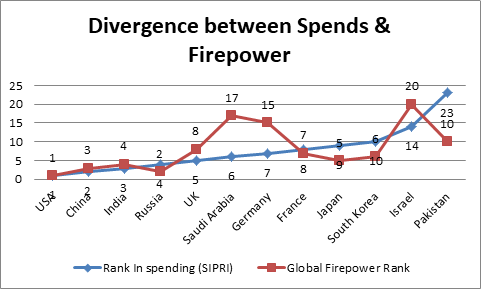
(4)As per the Stockholm International Peace Research Institute, while India spends $72.9 billion, 2.9% of GDP, on defence – the 3rd largest in the world – against China (1.7% of GDP), UK (2.2%), and France (2.1%). Saudi Arabia’s disastrous performance in the Yemen conflict despite spending 8.4% of GDP indicates that higher spends does not necessarily lead to better outcomes. Saudi is also the largest arms importer in the world – a sordid record which it shares with India – indicating the need for a better strategy, including indigenization.


(4)While Russia spends $61 billion – the 4th highest in the world - less than India’s $72.9 billion, it is rated the 2nd biggest in firepower behind the leader - the US.


Russia has been accused of interfering in the elections of EU (European Union) nations & the US – a reflection of his "cyber" capabilities & the ability of its intelligence agencies to penetrate political parties in other nations to run “influence” operations. Its “Aerospace Defence Forces” & “Missile Defence Forces” that provide additional teeth have been mentioned earlier. Despite Russia spending less than India, none dare attack the country, fearing a deadly reprisal consequent to its technological superiority. Replication of the Russian playbook a sane strategy – more so since they have been grandmasters of diplomatic chess.

The evolution of war:

Alexander, in the 4th Century BC, led land forces in his world domination sojourn; with improvement in ship building activities, over the last millennium, launch of naval forces followed which aided colonization activities of countries like Portugal, Spain, England, France, Holland etc. Wright brothers flew the first Aeroplane in 1903 & by WW I airforces made their entry.

World War II saw armour innovation in the form of German Panzer Tanks & their famed "blitzkrieg" strategy. The theatre of war evolved & the US, surprisingly, won the 1991 Gulf war, against Iraq, in days - unlike the "mother of all wars" that Saddam Hussain promised  - due to its “air power” & “network centric warfare”. The recent Azerbaijan victory over Armenia, in Oct -Nov 2020, was on account of cleverly using drone warfare; in the 1991 & 2020 conflicts tanks looked like sitting ducks. It is likely, that Future wars shall be fought, from afar, without soldiers needing to cross their national borders.

Israel bombed Iran's nuclear facility via an airforce strike in 1981; circa 2010, it disabled 1000 of the 5000 centrifuges to derail production of enriched uranium, needed to make a nuclear bomb - a process repeated again in 2020-2021 revealing its Israeli strides in Cyber warfare. Closer home, in 2020, a cyber-security breach, attributed to the North Korean group Lazarus, was detected at India’s Kudankulam nuclear reactors, perhaps to steal thorium based nuclear reactor technology that India is developing.

As per the Maharashtra Energy Minister, Nitin Raut, the Oct 12 2020 Mumbai power outage suggested a possible cyber-attack traced to malware from China, UK & other places; he announced ban on Chinese equipment henceforth. These incidents could be linked to the Indo-China Ladakh clash which as per a New York Times report quoting a Cyber security firm "Recorded Future": “a message from Beijing about what might happen if India pushed its border claims too vigorously”

Similarly, the forced shut down of the National Stock Exchange on Feb 24th 2021, surprisingly, due to simultaneous glitches detected in the leased lines provided by both the Telecom providers, evokes suspicions of a “foreign hand”.

It is surprising how an IT superpower like India has less than adequate Cyber warfare capabilities.

Stunned by the Chinese Anti satellite(ASAT) weapon Test in 2007, India as per Ashley Tellis, in a Carnegie Endowment for International peace, article titled “India’s ASAT Test – An Incomplete Success” on April 15th 2019, conducted a similar hit in Feb 2019 while failed but achieved success later in Mar 2019. He warns however that China has surged ahead beyond lethal ascent interceptors or co-orbital attack satellites - with a potential to produce debris & consequent international condemnation as it affects other orbiting satellites, even of friendly nations too - to use of advanced ground based directed energy weapons – lasers or high power microwave systems as alternatives. Low energy lasers can damage the electro optical or infrared sensors effective against most of Indian satellites in low earth orbit.  Ground based high energy lasers or space based microwave systems can permanently destroy the electronic circuitry of systems without creating unwanted debris associated with a physical collision. China is pursuing co-orbital service satellites that manipulate their trajectory or physically damage them by mechanical means - such as robotic arms rendering the spacecraft inutile to its possessors. China has the capability to target India’s master control facilities – other nodes in its telemetry, tracking & control network – through both space based jamming & precision air & missile strikes or destroy space platforms through high altitude nuclear explosions. China has been developing “asymmetric” counter space technologies to target US operational dependencies, which their strategists believe reside in inordinate reliance on space for their conventional military success. India must therefore develop an effective space situational awareness & operationally responsive emergency space launch capabilities, space deterrence strategy & space doctrine, he concludes.

Conclusion

The theatre of war has evolved into the Cyber, Space, Electronic & Psychological warfare domains, while India is still reliant on a manpower centric army accounting for 83% of the total armed forces of 14.45 lakhs. The Global superpower, US, meanwhile, only has a 14 lakh armed forces of which Army is 4.9 lakhs (35%) only; the corresponding figures for Russia are 10.14 lakhs & 3.5 lakhs (34.5%) respectively.  Russia, like India, is located in a troubled neighbourhood but spends only 15% of its Defence budget on the Army while we spend about 55%. Our pension expenses are  about 26% of the total Defence expenditure & reduction of army's manpower shall aid its control.

The US – India –Japan – Australia –  Quad grouping is largely a "Maritime partnership" which needs India to enhance its Naval spends to at least 25% of the defence budget, against 15% now, just like Russia. Focus on submarines, some of them permanently deployed in the South China Sea, shall be the key.

An IT superpower like India should quickly enhance its cyber warfare capability through greater university & private sector connect. ISRO’s (Indian Space Research Organization) success should be used to lure brilliant minds into space research & creation of Anti-satellite ASAT weapon systems using laser, microwave & robotic technologies. Creation of “asymmetric warfare” techniques rather than investment on higher manpower is critical to enforce deterrence.

Rationalization of the army to remove fear in the Navy & Airforce of being swamped by the much larger Army, in the proposed “joint theatre commands” might be a preferred option.  It is important to first get our Joint Forces doctrine out, reduce the size of the army, enhance the size of the navy, and build our Cyber, Space,  Electronic & Psychological warfare capabilities before shifting to the joint theatre command structure.