Monday, 29 June 2015

The Emergency 1975-77: A Critique

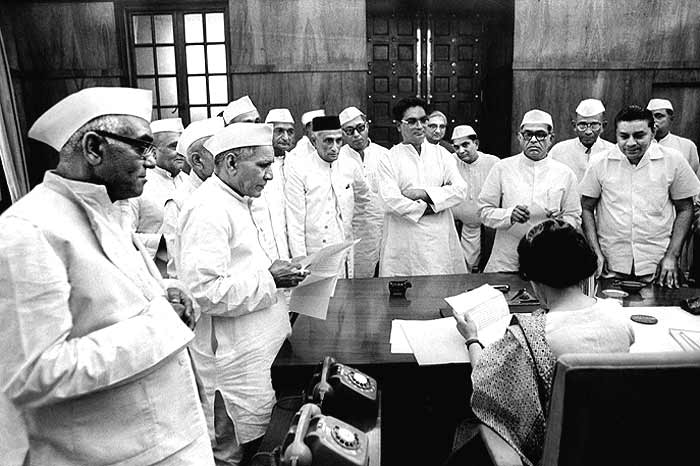
The 40th anniversary of the emergency, in India, on 25th June 2015, was marked by intense debates courtesy L K Advani’s assertion to the “Indian Express” some days earlier that he cannot say with conviction that a similar draconian intervention shall not be repeated. Emergency lasted for 19 months between 25th June 1975 till Jan 1977 when general elections were announced & was finally revoked on 21st Mar 1977 after Indira Gandhi lost the elections; she lost from Rae Bareli while her son Sanjay – credited with most of the excesses during the said period – from neighbouring Amethi. Rumours persist that Indira tried to rig the election results by exerting pressure on the returning officer – the young IAS officer, Vinod Malhotra – as well as influence the army to impose martial law, both of which failed, perhaps, because of the brave professionalism displayed by remarkable individuals representing reputed institutions.

However, not all institutions – designed by the founding fathers of the constitution to create adequate checks & balances – covered themselves with glory during this dark period. The 4th estate – the press – in Advani’s words crawled when it was merely asked to bend. The "Indian Express" & "Himmat" were some of the few exceptions. The Congress’s quest for a “committed judiciary” – in the words of Mohan Kumaramangalam – post the Kesvananda Bharti case led to A N Ray being appointed as the Chief Justice, in 1973, superseding 3 senior judges who were part of the majority judgement. Similarly, post the ADM Jabalpur case or the  habeas corpus case, the dissenting judge, HR Khanna, was punished with supersession. While the incumbent Chief justice then was A N Ray (73-77) the other 3 judges, who were part of the majority judgement - MH Beg (77-78)   Y V Chandrachud (78-85) & PN Bhagwati (85-86) - went on to become Chief Justices during the period 1973-86. Only Bhagwati publicly regretted his 1976 judgement, much later in life.

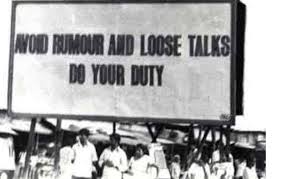
“Batein kum, Kaam zyada” was the slogan raised by the Congress & punctuality at govt. offices was rigorously implemented. Trains running on time delighted the middle class despite suspension of civil liberties. About 34988 people were arrested under the draconian MISA (Maintenance of internal security) provisions that circumvented the judicial process while another 75818 languished in jails under various Defence of India (DOI) rules; this crushed political opposition since their entire leadership was  incarcerated – a ruthless replication of  the British suppression of the  “quit India” movement in 1942. Mohan Dharia opines that Indira withdrew the Emergency just before submitting her resignation for she feared being arrested under MISA otherwise.

Stories of valour abound. Resistance was offered by some young Turks who occupy the top slots across political parties today. BJP's Sushma Swaraj pleaded the “Baroda Dynamite case” for George Fernandes while her colleague Arun Jaitley - President of the JNU students union in 1974 - was jailed. The current PM Narendra Modi too distinguished himself during this period which explains his meteoric rise thereafter. Leftists who distinguished themselves include CPI(M)’s Prakash Karat & Sitaram Yechury while Lohiaites Lalu Yadav, Mulayam, Sushil Modi & Nitish Kumar cut their political teeth during the said period. Journalist Shekhar Gupta cheekily observes that Indira, therefore, unwittingly, strengthened democracy by helping throw up new talents who were responsible for the Congress’ nemesis in subsequent elections.

Emergency has spawned many literary & cinematic representations. Coomi Kapoor’s “ The Emergency: A personal history”, Kuldip Nayyar’s “The judgement” & “Emergency retold” along with the Justice Shah commission’s report  – whose copies were purportedly destroyed by Indira Gandhi post returning to power in 1980 – give a chilling glimpse of those troubled times.  Salman’s Rushdie’s “Midnight’s Children” has certain sections based on the said period for which Indira did seek a court injunction. If “Garm Hawa” was, perhaps, the best take on the pangs of partition, the 1989 Malayalam movie “Piravi” best epitomized the troubles of the emergency. Piravi is a moving account of a father’s search for the whereabouts of his son who had disappeared during the emergency; critics attribute it as a take on an REC Calicut student Rajan’s disappearance post a purported arrest on the charge of being a Naxalite. Other films like Gulzar’s “Andhi”, Amrit Nahata’s “Kissa Kursi ka”, IS Johar’s “Nasbandi” are also based on the emergency. That begs the question

Why was the Emergency imposed?
Indira Gandhi was convicted by the Allahabad High court on 12nd June 1975 - for electoral fraud perpetuated in 1971 - on a case filed by Raj Narain & argued by Shanti Bhushan – who later held the law ministry portfolio in the Morarji Desai’s govt. She was implicated by Justice Jagmohan Lal Sinha of being guilty on charges of using the state police to build an electoral dais, availing the services of a government officer, Yashpal Kapoor, during the elections before he had resigned from his position, and use of electricity from the state electricity department. Her election was declared null & void & she was debarred from contesting elections for 6 years.

Justice V R Krishna Iyer – a Kerala state minister earleir in the CPI (M) govt. of EMS Namboodiripad (1957-59) & a doyen of civil liberties - on 24 June 1975, upheld the High Court judgement and ordered stoppage of all privileges Gandhi received as an MP. She was debarred from voting but allowed to continue as Prime Minister which meant that she could not take part in parliamentary proceedings. Indira’s
closest advisers then were the Bengal Chief Minister S S Ray, the Congress President Devakanta Barua who famously coined the slogan “India is Indira & Indira is India”, Law Minister HR Gokhale, Mumbai Pradesh Congress Committee President & chief fund collector Rajni Patel & Principal secretary PN Dhar. A paranoid Indira decided, perhaps, under advice from Siddhartha Shankar Ray decided to impose the emergency to continue her hold on power; surprisingly, SS Ray was the first to defect after the Congress defeat in the 1977 elections & deposed against Indira Gandhi before the Shah Commission

RK Dhawan – the secretary to Indira during the said period –claims that Indira in fact wanted to resign post the judgement but was prevailed upon by her cabinet colleagues led by Jagjivan Ram – who later dumped her & joined the opposition - & P N Haksar – later her trenchant critic – prepared the press statement accordingly. He believes that decision to impose the emergency was not triggered by the adverse court judgement but was under consideration from about a year earlier & was later prompted by SS Ray’s letter to Indira in Jan 1975 asking for “drastic action” to control the lawlessness that was spreading across the country. President, Fakhruddin Ali Ahmed, he claims, signed on the proclamation without much prodding. 

Why the lawlessness?
The 1971 Bangladesh war spurred inflation that was accentuated further by the subsequent drought in 1972 & international oil crisis in 1973. This caused resentment amongst the public which triggered the “Navnirman Andolan” (Dec 1973 – Mar 1974), in Gujarat, that catapulted the opposition “Janata Morcha” - a coalition of Congress (o), Jan Sangh, PSP & Lok Dal - to power in that state. The huge corruption allegations in Bihar compelled Jaiprakash Narayan (JP) to call for a “Total Revolution”. George Fernandes led a strike crippling the Railways in May 1974. while. L N Mishra – the influential Minister of Railways in the Central Cabinet was suspiciously killed in a blast at Samastipur, Bihar, in Jan 1975. “Mitrokhin papers” suggest that Mishra - one of the chief fund raisers of the Congress - was accepting money from the KGB. Was he an unfortunate victim of the internal politics within the Congress or was he eliminated as part of the KGB/CIA slugfest on Indian soil is hard to guess.

Clearly winds of change were blowing across the country. India was on the cusp of transitioning from a single party rule to a multiparty one & Indira wanted to stall the shift at any cost. Likewise, the assassination of Allende in Chile, created in Indira, a fear psychosis, that the same fate awaited her, courtesy the machinations of a “foreign hand”. The convergence of all those vectors created grounds for the imposition of the emergency.

The 20 point program announced soon after was chillingly similar to Adolf Hitler's 25 point program announced in 1920 which helped the latter constitutionally seize unbridled power. The "ordinance" raj &  "rule by decree" that followed destroyed the democratic processes that Indira's father, Nehru, so deeply espoused.

The Excesses of the Emergency
The first casualty of the emergency was the then I & B Mininter, IK Gujral, who resigned post being ticked off by Sanjay Gandhi for not carrying a Congress political rally on DD & not couching the Allahabad judgement in a softer language on AIR. VC Shukla replaced him & took censorship to new heights of belligerence. Jagmohan – the head of the Delhi Development Authority (DDA) – applied to himself the epithet “Haussmann of India”- as a reminder of the Frenchman responsible for the transformation of Paris between 1853 & 1870; with the support of Sanjay, he forced the Turkman gate demolitions & compelled the displaced to shift to Trilokpuri, in a bid to beautify Delhi. Sanjay followed through on the sterilization program with gusto which created angst that got reflected in the elections of 1977. Sanjay - as per Ram Guha- was the closest India came to a fascist


In the words of R K Dhawan, Sanjay was influenced by Zail Singh, SC Shukla, ND Tiwari, Gokhale & Bansi Lal to believe that he was in fact more popular than his mother. He therefore became an extra constitutional authority & as per Nirad C Choudhary had the knack of “attracting riffraffs” who were responsible for both the excesses during the emergency; a part of the same brigade were responsible for the 1984 Delhi riots too.

Sanjay mysteriously, wielded enormous power on his mother, the reason still in the realm of speculation. RK Dhawan claims that Sanjay joined politics only post the 1975 supreme court judgement & started organizing rallies in Delhi supported by Mr Jagmohan, then DDA vice-chairman, Mr B R Tamta, then MCD commissioner, and P S Bhinder, then DIG police. They influenced Sanjay to order uniform sign boards on all shops, price tags & demolitions.

Lewis M Simmons’s Washington Post article – released after he was deported from India for penning an article that army officers were unhappy with the imposition of the emergency – accusing Sanjay of slapping Indira, 6 times, at a private party, before the imposition of emergency, spread like “wildfire through word of mouth” as per Coomi Kapoor with the caveat that its authenticity is however doubtful.

Why Did Indira announce elections?
Indira announced elections in 1977, perhaps, convinced by the Intelligence Bureau (IB) that she would secure a comfortable majority. Others argue that burdened by a feeling of guilt for the excesses committed during the emergency, she wanted to make amends. Some critics interpret the accusations of “dictatorship” in India during the Pak elections pained Indira who was conscious of her international image erosion; she took this unexpected decision to protect the legacy of her family - including her illustrious father.

Sanjay was in the dark regarding this decision, some allege, while others believe that he too went by the IB ‘s observation & acquiesced to the decision to formalize power democratically. However, the elections threw up an unexpected result.

Why did the Congress Lose in 1977?
Critics argue that the IB’s analysis of a simple majority was not off the mark when it was made. The opposition was in jail & in disarray while the middle class was largely impressed with punctuality in govt. offices. The twist in the tale happened with leaders like H N Bahuguna, Nandini Satapathy & Jagjivan Ram belonging to the "Congress for Democracy" (CFD) defecting to the opposition ranks just before the elections. The opposition unity under JP – the “Gandhi” of Independent India – triggered a tsunami that washed away the Congress in entire North India; the Vindhyas stopped a congress rout. That begs the question

Why did the Congress sweep the South but was wiped out in the North in elections 1977?
The Akalis under Sant Longowal raised a banner of revolt, against the emergency, in Punjab while the JNU student unions did so in Delhi. Charan Singh charisma ensured victory in the Jat lands of UP, Rajasthan & Haryana.  The RSS played the role of the resistance movement in its bastions - West & North India. The left led the movement in Eastern India. JP's overall leadership of bringing diverse political faces together helped in increasing the index of opposition unity. 

It is alleged that the relentless & reckless implementation of Sanjay’s diktats in North India turned deleterious while the circumspection & candour displayed by Congress CM’s in the South – Devaraj Urs in Karnataka & Jalagam Vengal Rao in AP – helped in voter consolidation. The leaders of the resistance did not have any influence in the South either. Congress(I), therefore, won 41 of the 42 seats in AP & 26 of the 28 seats in Karnataka, 11 of 20 in Kerala & 14 of 39 in Tamil Nadu. Thus south accounted for 92 of the 153 seats won by the congress.  Coincidentally, the south came to the Congress’s rescue in 1989 too, when it was plagued by the Bofors controversy.

In Tamil Nadu, K Karunanidhi’s DMK govt. was dismissed in Jan 1976; he had opposed the emergency. While the "sympathy factor" should have ideally helped the DMK to return back to power, smeared as it was by corruption scandals, it lost the 1977 elections miserably. Had Rajaji or Kamaraj been alive, Congress would have found it difficult to to penetrate Tamil Nadu. The presence of the ADMK as well as the death of stalwarts - Rajaji of the Swatantra Party in 1972 & K Kamaraj of the Congress (O) in 1975 - helped Congress (I) get 14 of the 39 seats in Tamil Nadu.

Conclusion
The emergency is but a grim reminder of what could happen when institutional integrity is compromised at the expense of individual glory. When paranoia combines with megalomania the consequences are generally disastrous.

The excesses by the executive in trying to create a “compliant” judiciary in the 70’s - characterized by supersession of judges - has invited criticism while accusations of “non- transparency” has bogged the judiciary post the 2nd judges case in 1997 - that ruled the supremacy of the collegium over the executive in judicial appointments. Surely a middle ground is called for & hopefully it shall fructify soon. The remarkable judgements in the 2G, CWG, Coal Gate etc. would not have occurred but for an independent judiciary & safeguarding its jurisdiction is, therefore, absolutely essential.

It is critical to strengthen institutions like the Chief Vigilance Commission (CVC), Chief Information Commission (CIC) & the Lokpal. Intriguingly, the positions of the CIC & CVC were not appointed by the NDA govt. for over a year & the Lokpal still remains vacant. Such a lackadaisical attitude by any govt. needs censure.

Only by strengthening institutions & governments being amenable to criticism can India become a “participative democracy” from currently being only a “representative” one. In the words of Tagore “Into such world of freedom let my country India awake”.

Wednesday, 3 June 2015

Movie Review: Welcome to Karachi

The story is about two Indian dimwits who land up in Karachi, inadvertently, & their trials & tribulations of getting themselves extricated, first from the Baloch kidnappers & later FATA militants (Taliban) & the Pakistan Intelligence agencies. The movie loosely based on “Dumb & Dumber” relies on slapstick comedy & stereotyping of characters which might sound offensive to some. The storyline - a spoof on the internal situation of Pakistan - had promise but failed on delivery; it could have done with a spruced up script, better screenplay & editing. The garish graphics are a put off too.

Arshad Warsi (Shammi) is a court marshalled Naval officer implicated for sinking his submarine; his friend  Jacky Bhagnani (Kedar Patel) - the son of a Gujju event manager Dalip Tahil- is intent on going to the land of milk & honey – the US – by hook or by crook but suffers multiple visa rejections because of his idiosyncrasies. Therefore, when Kedar’s father asks them to organize, an event on a cruise ship they decide to use it as a getaway vehicle to reach the US. A comedy of errors ensures & they wander into a cyclone that capsized the boat & sweeps them into the beaches of Karachi – shown as a hotbed of violence. A bomb blast follows & the discovery, on the beach, of Arshad’s wallet - carrying his photo in Indian Naval paraphernalia - invites the attention of the Paki intelligence (ISI) agent Lauren Gottlieb (Shazia) who is soon on his trail assuming him to be the perpetuator.


Shammi & Kedar - shifted to a hospital post the blast - on realization that they are on enemy territory, dress to escape - in stolen clothing – only to be kidnapped by Baloch militia. Arshad dressed as a doc & mistaken for a trained physician - is forced to conduct a delivery, for which he relies on the Raju Hirani’s suction pump trick shown in “3 idiots” to emerge trumps. Later the duo visits the Indian embassy - to secure travel documents – where their indiscretions, yet again, trigger violence between the guards of various embassies. Karachi appears to be a trigger happy city.

They luckily escape the violence only to be kidnapped by Azhar Baloch. Patel’s father - like a good business savvy Gujju - negotiates the ransom for their release. Their interlocutor drops them at a bus stand –a Pathan territory - & reveals the rivalry between Pathans & Balochis; he advises them to collect their passports quietly & return home. Our heroes, in a bid to kill time enter a food stall & get so engrossed in a re telecasted cricket match featuring traditional rivals India & Pakistan that their identity gets revealed, inviting the ire of the Pathans. Arshad Warsi is truly in his elements here.

They flee again only to land into FATA – into Taliban hands - where they are intended to be used as suicide bombers. In a bid to escape from FATA they steal a mobile phone which is actually a detonator & unwittingly, blast the training camp that invites the attention of the American CIA – shown as manipulative & devious – intent on taking credit for destruction of the camp. They agree with the Americans as a quid pro quo for freedom only to land up into the machinations of the Pakistani politicians represented by their Interior Minister Malik who showcases them as patriotic Paki soldiers who have taken on the Taliban while the Indian media reveals their true identity. The cacophony of Indo-Pak debates on the Indian national TV is reproduced here.

Shazia alerts the duo to Malik’s intentions to finish them off – since they had become a diplomatic embarrassment; clearly humanity is not entirely lost on the other side of the border. The CIA rescues & releases them after they agree to grant credit to the CIA for destruction of the Taliban camp. The game of thrones thus completes a full cycle. On their way home at the Karachi airport they spot a Talibani militant dressed as a pilot & with the help of the Paki ISI destroy their plans of a hijack. Or have they?  


Finally Indians & Pakistanis coming together to finish a common enemy – the Taliban – is refreshing. The movie could have been a laughs riot had the direction been more effective; infantile humour was a let-down. Jacky tries desperately to sound Gujju while Arshad – whose repertoire is humour - looks lost. Lauren Gottlieb has a good screen presence & is an outstanding dancer while her acting capability just like her accent is a farce. The director Ashish Mohan gives the movie an abrupt end; perhaps he too had given up. In short watch this movie only if you fail to secure tickets for any other movie.

Thursday, 28 May 2015

Movie Review: Piku

Piku is the story of a cantankerous “constipated” dad played by Amitabh Bachchan (Bhaskor Banerjee) & his relationship with his fiercely independent daughter, played by Deepika Padukone (Piku) & the trials & tribulations of a cab owner Irrfan Khan (Rana Choudhary), unfortunately, stuck between the two. The movie is replete with humour but does not fall into the genre of a romantic comedy, although it had the potential to evolve into one.

It is a layered movie which explores the different shades of human character that is replete with surprising contradictions. Bhaskor is an eccentric man. He bats for “woman’s liberation” & denounces all women like his wife - condemning them to be of “low IQ” - for sacrificing their careers for the sake of their husbands; contrast this with the selfishness that afflicts him as a septuagenarian that forces him to torpedo his daughter’s marriage proposals - fearing the consequent loneliness.  Rarely do you see a father revealing to a potential suitor that his daughter is “not a virgin” & is “sexually & economically” independent. This hypochondriac’s calls to his daughter on the texture & colour of his poop when she is on a dinner date, destroy whatever little chances there are of consummation of her matrimonial alliance & his untimely calls to her when in office, cause discomfiture & embarrassment. Piku on the other hand is a modern woman who doesn’t hitch snapping back at her dad but loves him deeply & cares for him at her own expense.

Bhaskor - a widower - is a retired Bengali bhadralok living with his daughter Piku – an architect – in New Delhi. Piku’s business partner Jishu Sengupta (Syed) appears to have a soft corner for her & is her protective shield. Her casual reference to “sex” as a “need” - that can be satiated even outside of marriage - reveals the liberal outlook that the country is rapidly rushing towards. That no “moral police” has attacked the film on this count is, indeed, welcome. Moushmi Chatterjee (Masi) - Piku’s maternal aunt - is represented as thrice married that buttresses the “liberal” argument; speaking to Rana she jests that she is ready for a 4th one too. The dinner table discussions of the eclectic family instead of revolving around gastronomic delights ultimately centre on the gastro intestinal track & tummy issues that are indeed hilarious.

Bhaskor’s obsession with his “bowel movements” or rather the lack of it often puts Piku under constant stress. Maids quit unable to accede to his impossible demands: insistence on multiple cleanings of his toilet; & accusations of being kleptomaniacs. Paradoxically, he is an incorrigible salt stealer himself convinced that it is the desired solution to his problem. Perhaps, Bhaskor’s senility causes Piku irritation that finds an outlet on hapless cab drivers leading to many car wrecks; consequently, the drivers express reluctance to offer her their services.  On one such occasion  when one of the drivers - who was supposed to carry the father – daughter duo -  from Delhi to Kolkata – to visit their ancestral home -  fails to appear that the owner of the cab service company,  Rana , shows up & unwitting becomes part of a family drama. The movie is largely based on the encounters during this gloriously riveting road ride.

During the ride & after, Rana provides a rational viewpoint to the eccentric family. He offers his own unsolicited advice to the intractable bowel problem:  “Sitting in the traditional way” rather than the “English way” to exert the right pressure to facilitate “motion”; & a ingesting a traditional recipe of boiled “Tulsi & Pudina”.

The movie without being preachy alludes to the responsibility of the current generation to the geriatric ones. While the tantrums & belligerence of the older generation could be annoying, children cannot shirk their responsibility seems to be the message. Piku shows “how” to shoulder the responsibility. The film also encourages the cognoscenti not to destroy ancient buildings in the name of development; after all buildings are not necessarily built of mortar or stone alone, they carry nostalgic memories which are priceless – something that money cannot buy.

Bhaskor dies at his ancestral home at the end of the movie, post achieving victory over his bowel problem & learning to be at peace with life. Piku is finally liberated.

Big B plays his age & is adorable as the 70 year old while Deepika – in a deglamourized avatar - is lovable as a doting daughter. While Irrfan Khan does not have an author backed role, he allows his eyes to do most of the talking which is a delight.  Jishu & Moushmi are a strong supporting cast. 
The movie is not without its defects. Rana’s family – consisting of his mother & his sister separated from her husband – is introduced at the beginning of the movie but is not explored further. Rana reveals that his sister stole jewels from her mother-in- law to give it to her mother; this strand that highlights the complexity of human relationships, if worked on, could have made the movie much richer. The romantic track between Rana & Piku is not brought to a logical conclusion either.

Shoojit Sircar – the talented maestro - crafted the immensely popular “Vicky donor” (2012) & the thriller “Madras Café” (2013). While “sperm” was the hero of Vicky Donor, “motion” is the lead actor in Piku. The ability to trend into the realm of the unknown makes Shoojit unique & he does not disappoint yet again.  That family & their foibles when combined with wit & progressive thought can create a heart wrenching story that tugs at your heartstrings was revealed by Hrishikesh Mukherjee; Piku reveals that there is still an audience for his genre of film making. Take a bow, Shoojit Sircar.

Wednesday, 27 May 2015

Modi 365

Narendra Modi is celebrating the successful completion of his 1st year in office with the “Jan Kalyan Parv” (People Welfare Festival) - a blitzkrieg that includes 200 press conferences & rallies each along with a 360 degree media campaign. While the govt. pats itself with  the slogan “Saal Ek, Shuruaat Anek” (One Year, Many Beginnings) the Congress lampoons the ruling party with the slogan “Ek Saal, Desh Badhal” (One year, ill-fated Country)  while the CPI(M) adds insult to injury with “Ek Saal, Bura Haal”( One year, Bad Times). Clearly, our rambunctious democracy is at work.

Even the worst critics of the ruling dispensation concede that Modi is the lord of all he surveys – the Govt. & the Party; the current regime, therefore, escapes the plague of “dual power centres” – an accusation that dogged the previous regime. The contrarian view is that if, indeed, Pulak Chatterjee did take all govt. files to Mrs Sonia Gandhi  for direction, then by implication, the entire power lay at 10, Janpath & the accusation of “dual power centres” stands demolished. The net takeaway is that power when denied to the powerful on the issue or constitutionality or otherwise has other unintended consequences. Therefore, let such debates persist in the interest of creating a vibrant democracy.

Modi won a simple majority post a bitter campaign – a no holds barred one – where each of the parties outbid the other in calling names & used the media imaginatively.  In the words of Venkaiah Naidu, the Congress indulged in “corruption everywhere“ - under the ground (Coal Gate), over the ground ( CWG), in the air (2G) & the atmosphere (Antrix). Modi’s suave oratory of combining “2G” & “Jijaji” (Robert Vadra) did touch a chord with the audience & along with the much touted “Gujarat Model” of governance won him a majority – a present denied by the Indian electorate to any party for about quarter of a century.  Clearly, expectations are running high & it is against such pent up demands of an impatient electorate that we evaluate Modi’s contributions during the last one year in office.

Streamlining governance
Modi promised “Minimum Government, Maximum Governance” as part of his election campaign & “walked the talk” by starting his innings with under 50 ministers. By creating a “Margdarshak Mandal” & denying Ministries to his party-men who had crossed the age of 75, Modi has tried to set a retirement age for politicians in a country where politicians die or fade away but never retire; this was a welcome move. However, the paucity of talent in his ministry forced him to enlarge his team. While analysts continued to express their lack of confidence in the “quality of talent” even today the govt. believes that what the Ministers lack in experience is more than made up through hard work. Modi, however, shall be better served by a smaller but more talented team for which he should seek outside talent. For details read

It is to the BJP’s credit that despite all its spokespersons being elevated to the council of Ministers, the new spokespersons who have replaced their illustrious predecessors have distinguished themselves; paradoxically, this indicates the depth of talent in the party which the Ministry lacks.

Modi knows how to play the “Carrot & Stick” game. The Home Secretary, Anil Goswami, was supposedly sacked for trying to prevent the arrest of the Sharada scam accused - the former Congress Minister,  Matang Sinh. On the contrary, by making Nripendra Mishra, the Principal Secretary, through an ordinance route & S Jaishankar the foreign Secretary – unseating the incumbent – just a few days before his retirement, has sent a signal to the bureaucracy that performers shall be disproportionately rewarded; this has the potential to recharge the moribund bureaucracy. Critics agree that Modi has successfully disciplined the bureaucrats and ministers which is a welcome change. However, rumours of surveillance on ministers & media gag orders persist which is discomforting.

The recent arrest of certain elements - on charges of stealing govt. files - has sent a signal to the Industry not to meddle with governance, which is welcome. The govt. proudly claims that political agents & middlemen have been forced to retreat from the corridors of power in Delhi which is a tribute to Modi’s “strong leadership”

Foreign Policy
Modi has brought his own flamboyance & vigour to foreign policy; this was a necessity to gain international visibility after India had fallen off the perch in 2010, affected as she was by corruption allegations & the consequent paralysis of governance.  Modi initiated the “neighbourhood first” policy for regional acceptability is the first step to be crossed before being recognised as a world power. He has successfully strengthening relations with Japan & mended relations with the US – forgiving the sole superpower for denying him a visa during earlier years. The basic tenets of his diplomacy are: Enhance Economic component; Strengthen links with the Indian diaspora; & Smoothen strategic security architecture with like-minded countries; for details see

To contain China, Modi has initiated the “Bharat Mala & Sagar Mala” projects & has countered the Chinese “Road & Belt” project with “The Indian Spice route & Mausam projects”; for details see

The evacuation of 4500 Indians & nationals from 41 countries from war town Yemen as well as instant response to the earthquake in Nepal has enhanced India’s image as a nation; for details see.

However, Modi’s Pakistan policy is floundering post his cancellation of Secy. level talks & to his consternation, Pak is gaining leverage over Afghanistan – where we have strategic assets to protect. Not everything is quiet in the western borders & that is a cause of concern. Likewise, his non- engagement with the Middle-East - which accounts for India's energy security - is bewildering. Perhaps, he has an image to protect.

Economy
The economic mess in ’91 saw the Narsimha Rao govt. take instantaneous decisions, prepared as they were with the blueprint of what was to be done on returning to power; “economic reforms” thus happened. Knowing fully well the precarious status of the Indian economy, it was expected of the BJP to either come prepared with their blueprint or implement the one suggested by the mandarins of the finance ministry as soon as they were in the saddle.  During the course of the campaign, Modi purportedly requesting Arun Shourie to interact with the intelligentsia & the industry to draw up a roadmap for reforms & many analysts believe that he along with Piyush Goel, indeed, worked out the contours of such a policy. It was, therefore, widely expected that Arun Shourie would become the Finance Minister & along with Raghuram Rajan -who was already doing an outstanding job in steadying the financial system - complete a fine picture.

Surprisingly, Arun Jaitley became the finance Minister & his first budget was a rehash of P Chidambaram’s interim budget. With the private sector suffering from overcapacity, infrastructure companies loaded with debt & banks burdened from rising NPA’s , accelerating environment clearances or instituting single window clearances or tweaking of labour laws was unlikely to turn around the investment cycle; public investment would. With the govt. being served an unexpected bonanza in the form of a huge drop in international oil prices, the savings thus achieved should have been immediately deployed into public investments in the first year itself which they didn’t. Jaitley’s 2nd budget did but precious time was lost; for details of union budget 2015 & railway budget 2015 see

Social Affairs
Modi’s penchant for “development” was combined surreptitiously with “communal polarisation” by affiliate organizations at the ground level to gain electoral victories till Delhi stopped the juggernaut. Campaigns such as “Ghar Vapasi” , “Love Jihad” or attack on churches have created a fear psychosis amongst the minorities which does not do bode well for the social fabric of the country. History is witness to the fact that support extended to religious extremist elements like Brindanwale created the Punjab tangle which took more than a decade & the sacrifice of lakhs of lives before normalcy was restored.  With the Middle -East burning due to intra religious conflicts & countries like Nigeria & Myanmar struggling with inter religious ones, it is prudent to avoid religious polarisation as a route to seek power; neither is minority appeasement passing off as secularism or caste polarisation the solution.

Conclusion

That Modi is a hard working Prime Minister is a given. While the “Chai-wala” wearing “pinstipe suits” did cause some rancour, his efforts at rejuvenating the foreign policy and disciplining the bureaucracy has earned many plaudits. The world wants India to succeed & Modi is at the right place at the right time.  He has the potential to provide astute leadership to make India an economic & military power & help India get its rightful place at the high table – a permanent member of the UNSC. However, he has to discipline the fringe elements in his party if he is intent on seeking the stature of an “International statesmen”. Lee Kuan Yew once opined that Nehru was a “demagogue who choose not to be a dictator”. Only Modi has the answers on how he wants the world to remember him.

Wednesday, 20 May 2015

The clash of the Titans: Alibaba, Tencent & Baidu

Chinese government policies – protectionist or otherwise – have ended up creating behemoths like the South Korean chaebols. While Alibaba is the e-commerce giant in China with an 80% share, Baidu is the numero uno of Chinese search with about 60% share & Tencent - the largest internet services company in China - owns Wechat, the undisputed king of messaging.

Interestingly Alibaba’s e-commerce dominance is challenged by Tencent & Baidu to protect their own turf while Alibaba has started to challenge the might of the latter two in their areas of dominance. Each of the players is trying to cut into the other's core business either through acquisitions or sometimes through strange tie ups - of the kind listed earlier. Surprisingly, there was little overlap between the players earlier till China became the largest smartphone market & consumers started using those devices for almost everything: shopping, food ordering & booking restaurants, group purchases, taxi hailing, booking tickers for flights, hotels, cinema etc.  The clash of the Titans was therefore inevitable & is now just unfolding.


Tencent has also bought a 15% stake in JD.com - China’s second-largest e-commerce company - to tighten the screws on Alibaba. It has launched ventures to integrate e-commerce and online finance services with WeChat. Simultaneously it has taken a stake in the 2nd largest Chinese search engine Sohu's Sogou too to take on Baidu, It is an interesting battle where Tencent joins hands with Baidu to challenge Alibaba while simultaneously taking on Baidu on search.

Alibaba is not sitting quiet either; it has picked up a stake in Sina Weibo - a twitter equivalent - to take on Tencent's WeChat. Will Alibaba take a stake in Qihoo 360 technologies - that is currently independent - & which runs the 3rd largest search engine in China & provides security software or push its own search engine Shenma? Only time will tell.

O2O (Online – to- offline)
Online-to-offline is the biggest cake in e-commerce; creating a rebound between offline & online by leveraging tech enablers is the way forward.

Dalian Wanda group is China’s biggest commercial land developer. Wanda, Baidu and Tencent have created a joint venture in the ratio 70:15:15 with the aim to take on Alibaba. The new group melds Baidu’s search capabilities and Tencent’s popular WeChat social messaging network with Wanda’s brick-and-mortar infrastructure & will develop services, including online finance that could pose a challenge to Alibaba’s popular banking service, Yu’ebao. Wanda said it estimates its shopping malls and other outlets will attract 5 billion customers a year by 2020, making the company the “world’s largest offline commerce platform.” Wanda hopes that users of Tencent’s QQ instant messaging service & social mobile platform WeChat will become customers at its shopping malls, movie theatres and hotels through this new e-commerce platform. Wanda thus is trying to protect its offline business.
Complementary technologies
The fight for content is getting competitive & uglier with each passing day. Control over delivery vehicles as well as gaming platforms is also getting hastened.

Baidu fired the first salvo by buying Internet video business PPStream Inc. in June 2013 for $370 million and combining it with IQiyi.com, which it acquired in 2012. It intends to buy distribution rights for about 1000 Holywood movie titles,produce 7 local films, buy TV shows, co-produce content & create Chinese adaptations of US content.

Ma responded, in 2014, by buying a stake in Youku Tudou, a Chinese equivalent of Youtube. He also bought a controlling 60% stake in ChinaVision Media Group Ltd for $804 million, giving it access to TV and movie content & diluting Tencent’s stake from 8% to 3%. He has succeeded to hit two birds with oen stone. Along with Ali TV operating system launched in 2013 & mobile gaming platform in 2014, In 2013, Alibaba released a smart TV operating system with Wasu – an internet TV company in which Alibaba acquired a 20% stake for $1.05billion - and a set-top box while in January 2014 it started a platform hosting mobile games to compete with Tencent. Clearly Alibaba is strengthening its content & delivery platforms to take on both rivals Baidu & Tencent.

Mobile
In 2014 Alibaba acquired UCWeb - a web browser & search company – which it combined with UC Mobile - one of its business units – to oversee its browser, mobile search, location-based services, mobile gaming, app store and mobile reader operations. Baidu, reportedly tried to buy UC web in June 2012. The deal with UCWeb – with more than 500 million users globally - is valued at more than double the $1.9 billion that search engine Baidu Inc. paid last year for app store operator 91 Wireless Websoft Ltd. Surely the titans are helping in skyrocketing valuations.

UCWeb has a 50% market share amongst web browsers in China & holds a 35% market share in India. Though Alibaba currently has a dominant market share in mobile e-commerce, analysts believe that smartphone users may gravitate to its rival Tencent - which runs the massively popular WeChat mobile messaging and social-networking application. Alibaba’s moves are to checkmate such a transition. UCWeb will also be able to develop browsers and other tech it needs for its smart TV ecosystem and e-commerce businesses.

Car Apps
E-commerce firms view logistics as the next strategic lever to gain dominance & therefore are buying stakes in taxi apps; delivery through taxis, perhaps, is the way forward. This is another way of monetizing its “mapping” assets.

Hangzhou Kuaidi Technology Co., a taxi-booking service is backed by Alibaba, while Didi Taxi, is backed by Tencent. Alibaba also has a stake in Lyft; Baidu therefore has invested in the San Francisco based Uber & will connect its map and mobile-search features with Uber’s service.

Current Strategic Matrix
The current status of the category presence of each of the titans - either on their own or through a strategic stake buy- is listed below. The listings in “green” indicate the market leader in the US & China. The blank spaces are indicative of potential areas of conflicts; acquisitions or strategic buys would be a logical corollary.

Category
Google
Baidu
Alibaba
Tencent
Market Leader US/China
Search
Google Search
Baidu Search
Aliyun Search
SOSO/Sogou
Google/Baidu
Mobile O/S
Android
Android
Aliyun O/S

Android/
Web Browser
Chrome
Baidu Browser
UCweb
TT (Tencent Traveller)
Chrome/UCweb
Maps
Google Maps
Baidu Ditu
Autonavi

Google/Baidu Ditu
Video
Youtube
Baidu Video/iQiyi
Youku Tudou

Youtube/ Youku Tudou
E-Mail
Gmail


Gmail/
Cloud Storage
Google Drive
Baidu Wangpan
Aliyun Cloud/Kanbox
Tencent Weiyun

Google/Aliyun
Social Network
Google +
Baidu space

Qzone
facebook/
Microblogging


Sina Weibo
Tencent Weibo
Twitter/Sina
Shopping
Google Shopping
Baidu Shopping
Taobao/Alibaba/Tmall
Paipai/ Stake in JD.com
amazon/Taobao
Music
Google Play
Baidu Music
Xiami

Pandora/Xiami
Augmented Reality
Google Glass
Baidu Eye


WIP
Payment
Google Wallet

Alipay
TenPay / Weixin / Payment
Paypal/Alipay
Gaming
Google Play
Baidu Games/91 wireless

QQ game platform

Messenger service
Google Talk


QQ / Weixin / WeChat
/WeChat